A series of pop-science articles on mirror matter theory (i.e., 镜像世界探秘系列) written since 2020 are translated from Chinese to English using Gemini 3.5 flash.
Exploring the Mirror World 0—Introduction
In this series of articles, I will introduce my research on the new physics of the mirror world in relatively accessible language, roughly following the chronological order in which these ideas were conceived and completed. The tentative plan is to write ten popular science articles (corresponding generally to the ten papers I have completed).
First, I will introduce the motivations from nuclear astrophysics—explaining why a new mirror world theory is required and how it can resolve current crises in stellar evolution and nucleosynthesis.
Next, I will discuss how to construct this new model and simultaneously apply it to solve a series of major puzzles in fundamental physics and cosmology (including dark matter, dark energy, matter-antimatter asymmetry, the neutron lifetime anomaly, neutrinos, CKM matrix unitarity, and more).
Then, I will demonstrate how to utilize existing technologies to design various experimental setups, with the hope of rigorously testing this model and precisely measuring its parameters directly in the laboratory.
Finally, I will show how to extend this phenomenological model from first principles into a series of Supersymmetric Mirror Models, applying them to reshape our understanding of Big Bang dynamics, gravitation, and the interiors of black holes.
Through these introductions, I hope to spark the interest of promising young minds in this theoretical framework and its experimental validation. It is my sincere hope that they will venture further down this—at least in my view—highly promising path. Even more so, I hope that those who currently possess the capabilities or control the funding will genuinely push forward with these experimentally mature tests using current technologies. If interested, please feel free to contact me.
Exploring the Mirror World 1—The Romance of Mirror Matter Theory
This article is based on the introductory sections of the following papers: “Neutron oscillations for solving neutron lifetime and dark matter puzzles” and “Laboratory tests of the ordinary-mirror particle oscillations and the extended CKM matrix”, as well as the core ideas of all my related work (see the blog post “Does Another Mirror World Exist in Our Universe?”).
The developmental history of Mirror Matter Theory will be presented here through my personal perspective and understanding. It is certainly not an exhaustive history. However, the core concept of mirror symmetry will take center stage in this and subsequent articles. Note that this mirror world theory is completely distinct from other similar-sounding conjectures, such as the many-worlds interpretation of quantum mechanics, the multiverse of string theory, or other parallel universe concepts.
1. Symmetry and Parity Violation
Symmetry is a primary object of study in physics, especially in modern physics. Before the 1950s, the fundamental theories of physics were always thought to conform to the beauty of symmetry. However, it was not until 1956, when T.D. Lee and C.N. Yang discovered that parity symmetry is violated in weak interactions, that physicists’ faith in this conservation law was shaken. Parity ($P$) represents a space inversion symmetry (the transformation of spatial coordinates from $x, y, z$ to $-x, -y, -z$). Its violation directly leads to a breakdown of left-right symmetry. Upon learning of Lee and Yang’s theory, Chien-Shiung Wu quickly provided experimental verification using the $\beta$-decay of Cobalt-60. Lee and Yang received the Nobel Prize for this, though Chien-Shiung Wu regrettably missed out on the honor she deserved.
The significance of parity non-conservation is profoundly deep, and modern physics still understands it far from fully. The mirror world model introduced below is a natural extension of parity violation. In their classic parity non-conservation paper, Lee and Yang initially speculated that our world might possess distinct left-handed and right-handed protons to extend parity symmetry. However, it turned out that strong and electromagnetic interactions do not violate parity conservation, and such protons do not exist.
2. The Historical Trajectory of Mirror Matter
After a decade of silence, three Soviet physicists (Kobzarev, Okun, and Pomeranchuk) first proposed the possible existence of mirror particles in 1966. Their inspiration came from the then-recent discovery of $CP$ violation, which showed that charge conjugation (matter-antimatter transformation) combined with parity inversion is also not conserved in weak interactions. They proposed that mirror particles are nearly identical to the ordinary particles in our world, but participate in their own gauge interactions (essentially a replica of our world’s gauge interactions). Aside from sharing gravity, they hypothesized that mirror particles might couple via weak interactions, albeit very weakly. Their thinking was far ahead of its time, considering the Standard Model of particle physics had not even been truly established yet. Furthermore, they did not realize that the mirror particles they imagined could solve the mystery of dark matter, which Fritz Zwicky and others had proposed back in the 1930s.
What followed was an even longer period of silence. Aside from these few Soviet physicists, almost no one paid attention to the concept of mirror symmetry. Years later, Okun published a historical note in the English translation of a Russian physics journal (Physics-Uspekhi, 2007). In the early 1980s, two other Soviet physicists, Blinnikov and Khlopov, revived the possible existence of mirror particles through qualitative discussions from an astronomical and cosmological perspective. Shortly thereafter, in 1984, superstring theory achieved its first revolutionary breakthrough. The $E_8 \times E_8$ superstring, which embodies the concept of mirror symmetry, was proven to be anomaly-free. Physicists from the United States and other countries finally began to get involved.
First came a major article in Nature in 1985 titled “The shadow world of superstring theories” by the famous University of Chicago cosmologists Kolb, Seckel, and Turner. They detailed and convincingly demonstrated the elegant realization of mirror symmetry within a cosmological framework, particularly its compatibility with the cold dark matter model of Jim Peebles (2019 Nobel Laureate) and Big Bang nucleosynthesis. Due to the Cold War, they were completely unaware of the Soviet work mentioned above and did not cite those early papers. Kolb and Turner later co-authored the classic cosmology textbook The Early Universe, and their Nature article remains equally classic.
From then on, although mirror matter theory still did not enter the mainstream, it began to garner a dedicated group of supporters. Prominent figures among them included Hodges, Mohapatra, Foot, and Berezhiani. A young Hodges at the Harvard-Smithsonian Center for Astrophysics published what appeared to be his final physics paper in 1993, “Mirror baryons as the dark matter”. It seems he left academia after his postdoc because he could not secure a permanent academic position. Professor Mohapatra, an Indian-American physicist at the University of Maryland, has been an active proponent of mirror matter theory since the 1990s and has published numerous related papers.
The Australian physicist Robert Foot was perhaps the most fanatical supporter of mirror matter theory during this period, likely publishing the highest number of papers on the subject. He also published a popular science book in 2002, Shadowlands: Quest for Mirror Matter in the Universe. Starting in the 1990s, a plethora of mirror matter models emerged to explain dark matter, neutrino oscillations, and so forth. Perfect symmetry between the ordinary and mirror worlds would completely decouple them, causing a series of theoretical and observational difficulties. The typical approach was to introduce some weak interaction between ordinary and mirror particles to induce a tiny symmetry breaking. The mirror model Foot championed most generated this breaking through a kinetic mixing of the electromagnetic gauge interactions of the two worlds ($U(1)$ kinetic mixing). The bulk of his papers are based on this model. In a recent peer-review report I received, an anonymous referee claimed that Foot no longer firmly believes in mirror matter theory; I hope this is not true.
Another staunch and prolific scholar of mirror matter theory is the Italian physicist Zurab Berezhiani. He has also published a large number of articles on mirror theory, favoring a model that introduces mirror symmetry breaking via a six-quark coupling (a dimension-9 operator). Although it seems he repeatedly and strongly blocked the publication of my related papers (an inference I drew from review reports; if I am mistaken, I apologize), I still wish to credit his work for inspiring me. In particular, the following two papers heavily influenced my early work: “Neutron–Mirror-Neutron Oscillations: How Fast Might They Be?” regarding neutron oscillations, and “Fast neutron-mirror neutron oscillation and ultra high energy cosmic rays”. Additionally, Professor Hong-Jian He’s research team at Tsinghua University has conducted very deep and meticulous studies on mirror matter theory: “Spontaneous mirror parity violation, common origin of matter and dark matter, and the LHC signatures”.
3. The New Mirror Model: Spontaneous Symmetry Breaking
All past mirror models relied on introducing an extra or artificial weak interaction between the two worlds to achieve symmetry breaking. In fact, the mechanism of spontaneous symmetry breaking can accomplish this completely on its own. All those additional interactions were merely superfluous. The spontaneous symmetry breaking mechanism was first applied to superconductivity theory, and later to the Higgs mechanism in the Standard Model to generate the masses of elementary particles. It is a phase transition mechanism widely used by physicists, and we will discuss its application in the new mirror model in detail in future posts.
Other concepts similar to mirror matter theory have also circulated within small circles. For example, the twin-Higgs model proposed by Chacko et al. is actually an incomplete mirror matter theory. There are also braneworld models based on superstring theory, which suggest that our known world is merely a brane embedded in a higher-dimensional bulk, thereby predicting that more such invisible braneworlds might exist. Such parallel world theories seem like a natural generalization of mirror matter theory, but in my view, they are quite likely just mathematical tools for new physics in the absence of guiding physical principles, much like superstring theory itself (resembling the relationship between Riemannian geometry and general relativity).
Before the end of 2018, I knew absolutely nothing about mirror matter theory. At that time, I was persistently puzzled by many riddles in nuclear astrophysics, such as stellar evolution, nucleosynthesis, neutron stars, X-ray bursts, and so on. I could not find solutions to these problems. Yet my intuition told me the issue must lie with neutrons and neutron-related reactions. Then, the theories and experiments regarding the neutron lifetime anomaly began to catch my attention. In particular, Fornal and Grinstein’s paper explaining the neutron lifetime anomaly using a dark matter decay model (“Dark Matter Interpretation of the Neutron Decay Anomaly”) sparked my thinking and ultimately led me to discover prior work on mirror matter theory.
I was struck almost immediately by the elegance of mirror matter theory. At the same time, I keenly sensed that the concept of mirror symmetry combined with the mechanism of spontaneous symmetry breaking was the key to solving all these problems. This would lead to oscillations between ordinary and mirror neutrons. Mathematically, neutron-mirror-neutron ($n-n’$) oscillations are nearly identical to neutrino oscillations, except that generation symmetry is replaced by mirror symmetry. I assumed someone must have already done something with such an elegant formalism, especially since the discovery of neutrino oscillations had been awarded a Nobel Prize just a few years prior. However, searching through past literature, I was surprised to find that almost all mirror models had superfluously introduced extra interactions.
Consequently, I re-examined neutrino oscillation theory and set about building my own mirror model. During the Spring Festival of 2019, I finally completed my first two foundational papers [1, 2]. One focused on stellar evolution and nucleosynthesis, while the other addressed the neutron lifetime anomaly and dark matter.
4. Turning Point: Theoretical Convergence and Experimental Prospects
I expected these papers to generate an immediate, massive response, and that many high-IQ physicists would build upon this model to solve various other puzzles, allowing me to take a complete rest. In reality, this was likely an illusion born of my over-infatuation with my own theory. Aside from polite invitations from my classmates and friends to give seminars on my new theory, there was essentially very little reaction. The only notable response came from Michael Brooks, a science writer for New Scientist magazine, who noticed my work and interviewed me. In the cover article he published, “We’ve seen signs of a mirror-image universe that is touching our own”, my work was evidently not fully understood; for corrections, see my blog post “Corrections to recent media coverage on the mirror matter theory”. Over the next few months, I calmed my mind and independently applied the new model to other issues, resolving the mystery of matter-antimatter asymmetry [3], the ultra-high-energy cosmic ray puzzle [4], and the problem of CKM matrix unitarity [5].
Particularly in paper [5], completed in June, I discussed in detail how to verify the new model in the laboratory. Cosmological and astronomical observations are not the ultimate tests of a model. This is because we only have one universe (at least, we only know of this one), and we cannot artificially alter the conditions of celestial bodies in it. The laboratory is different; we can change experimental conditions to test the model’s predictions under varying circumstances. Fortunately, the experimental proficiency and capabilities of today’s world are indeed capable of executing precise tests on this new model.
The next breakthrough came in a flash of inspiration while contemplating dark energy. By the end of August that year, I had written paper [6], which addresses conundrums like dark energy and neutrinos via a mirror extension of the Standard Model. A core idea was a reinterpretation of mirror symmetry, pointing out that it is actually a chiral symmetry connecting the ordinary and mirror worlds; the transformation of quantum fields between the two worlds mimics the $\gamma^5$ operator of Dirac matrices. Then, utilizing Nambu–Jona-Lasinio 4-fermion interactions and the staged quark condensation proposed in paper [3], a Higgs-like mechanism of staged spontaneous symmetry breaking was implemented to explain the mass hierarchy of quarks and leptons. Another key idea was a new understanding of supersymmetry (SUSY), building upon the quasi-SUSY concepts of Yoichiro Nambu (2008 Nobel Laureate).
This paper [6] evidently made an impact. People began to express interest in it. Notably, the theoretical physics group at Laval University in Canada immediately invited me to give a talk. Professor Grinstein of UCSD, whom I mentioned earlier and who also serves as an editor-in-chief for Physics Letters B, seemed to be influenced by paper [6] as well, playing a critical role in pushing my first paper through to publication. In fact, within less than two weeks of uploading paper [6] to the preprint server arXiv.org, my two mirror theory papers (which remain my only two so far) were accepted for publication. Grinstein’s postdoc, Fornal, came to the University of Notre Dame (where I am located) to interview for a faculty position shortly thereafter (around late November). I had lunch with him and maintained a brief but pleasant subsequent exchange. Unfortunately, Fornal did not receive an offer from Notre Dame. Yet, for reasons unknown, Professor Grinstein’s attitude toward my work suddenly did a 180-degree turn in early January of this year (2020), abruptly terminating an ongoing multi-round review of another paper of mine and rejecting it outright without providing any reason.
Losing the support of Professor Grinstein after months of good communication was certainly disheartening. However, during that period, I was far more concerned with how to advance the experimental verification of the new theory. Actually, right after writing the earliest two foundational papers, I was actively contacting experimental physicists who measure the neutron lifetime and the invisible decays of $K^0$ mesons. Many emails went unanswered. Only two people replied. One was Gninenko, head of the NA64 experiment at CERN; they were originally prepared to measure the invisible decay of $K^0$ mesons before the SPS shutdown at CERN, but failed to do so due to a machine malfunction. Once the SPS completes its upgrade and resumes operation, they will certainly continue this experiment.
The other was Peter Geltenbort of the ILL laboratory in France. He is a pioneer in Ultra-Cold Neutron (UCN) experiments and an enthusiastic, storytelling, fascinating person. We maintained very frequent email contact. I was extremely interested in using their custom-designed magnetic trap named “HOPE”, which can confine ultra-cold neutrons, to remeasure the neutron lifetime and validate my model. However, he officially retired at the end of August 2019. At his invitation, I visited the ILL laboratory in January of this year and gave a seminar. The primary objective was to talk with the person in charge of the HOPE magnetic trap about the possibility of restarting the experiment. Unfortunately, this individual was skeptical even about neutrino oscillations. I spent roughly two full afternoons in France convincing him (and I am still not entirely sure if I truly did) that the Nobel Prize for neutrino oscillations was not a mistake. I knew then that my hopes of restarting the HOPE magnetic trap would likely fall through, but at the very least, tasting various red wines and cheeses at the dinner party where Geltenbort warmly hosted me made the trip worthwhile.
Fortunately, through Geltenbort, I got in touch with Professor Chen-Yu Liu, a Taiwanese-American leader of the UCN$\tau$ collaboration. UCN$\tau$ is probably the largest team measuring the neutron lifetime using ultra-cold neutrons. They had just published their most precise measurement results using the “bottle” method in Science, which also serves as an important benchmark for the neutron oscillation mixing parameters in my new model. If they could build a new small magnetic trap based on my theory, it would serve as an excellent test of the new model. Professor Liu was clearly very interested initially and invited me to give a talk at Indiana University, where she was based, in early November 2019. However, deeper collaboration is not that easy.
At least I have Professor Liu to thank for putting me in touch with Dr. Mumm at the National Institute of Standards and Technology (NIST). Mumm was highly interested in my model and brought his colleague Coakley and Professor Huffman from North Carolina State University into multiple discussions with me starting late last year. The NIST magnetic trap they built is unique; it is the apparatus I am most interested in and believe can best validate the new model. In fact, in a PhD thesis by one of their students two or three years ago, an anomaly predicted by the new model had already been measured very precisely using this magnetic trap. However, an accidental loss of ultra-pure Helium-4 after the experiment ended left the conclusion uncertain, causing them to miss this potentially monumental discovery. The enthusiastic Coakley performed a vast amount of simulation work over the Christmas and New Year holidays, confirming that the new model can indeed quantitatively explain the neutron lifetime anomaly previously observed in the NIST magnetic trap. Yet, due to various funding and staffing hurdles, restarting the NIST magnetic trap experiment will likely take some time.
The next theoretical advancement was the formulation of full Supersymmetric Mirror Models and the evolution of spacetime dimensions [7, 8], proposed this past February based on paper [6]. Constructed from a new set of principles, these supersymmetric mirror models can naturally explain the origin of the arrow of time and the dynamics of the Big Bang. Immediately following this, paper [9], completed a month later, further elaborated on the relationship between gravity and quantum theory—viewing gravity/spacetime as a smooth geometry resulting from quantum mean-field effects after dimensional inflation. Concurrently, paper [9] utilized a two-dimensional supersymmetric mirror model and conformal field theory to elegantly describe the interior of a black hole horizon—a genuinely two-dimensional world.
Paper [6] also helped me establish contact with Professor Hong-Jian He at the end of this past February. He offered a great deal of help and advice, particularly in connecting me with the experimental high-energy physics community in China, primarily the BESIII team at Beijing. The presentation I gave to the key personnel of BESIII in March clearly aroused immense interest. The completion of paper [10] was precisely intended to provide better predictions and guidance for experimental testing in this domain. Under existing conditions, BESIII can just manage to reach the $10^{-6}$ sensitivity predicted by the new model for the invisible decay of the short-lived $K^0$ meson. The next-generation Chinese high-energy facility, the STCF (Super Tau Charm Facility), will certainly deliver more precise measurements of the invisible decays of $K^0$ and $\Lambda^0$, but its construction and commissioning will likely require at least a decade.
Papers [7, 9] appeared far too bizarre to many physicists; even the relatively open-minded preprint repository arXiv.org rejected both articles. Yet, it is precisely such exploration that has brought the general framework of the new mirror world theory to its basic completion today, though many details, particularly mathematical rigor, remain to be refined. The new theory can be applied to the study of many other issues, and it is high time that new physics be incorporated into various state-of-the-art, large-scale simulations concerning the early universe, stellar evolution, and supernova explosions. Obviously, one person cannot accomplish all of this alone. In particular, the laboratory testing discussed in papers [5, 10] requires a team with more manpower and physical resources to drive it forward. I believe that in the near future, as more aspiring young minds join us, we will ultimately unveil the mysterious veil of the mirror world, both theoretically and experimentally.
References & Preprints
For more discussions, see my blog: https://www.wanpengtan.com
Download the latest versions of the academic papers: https://www.wanpengtan.com/smm/
-
[1] arXiv:1902.01837, or Phys. Lett. B 797, 134921 (2019) — Neutron lifetime anomaly, dark matter
-
[2] arXiv:1902.03685 — Stellar evolution and nucleosynthesis
-
[3] arXiv:1904.03835, or Phys. Rev. D 100, 063537 (2019) — The mystery of matter-antimatter asymmetry
-
[4] arXiv:1903.07474 — Ultra-high-energy cosmic rays
-
[5] arXiv:1906.10262 — Laboratory tests
-
[6] arXiv:1908.11838 — Dark energy, neutrinos
-
[7] https://doi.org/10.31219/osf.io/8qawc — Supersymmetric mirror models
-
[8] arXiv:2003.04687 — A popular discussion on supersymmetric mirror models
-
[9] https://doi.org/10.31219/osf.io/2jywx — Black holes, gravity
-
[10] arXiv:2006.10746 — Invisible decays of $K^0$ mesons, $\Lambda^0$ and $\Xi^0$ baryons
Exploring the Mirror World 2—The Mystery of Stellar Evolution and Nucleosynthesis
My long-term contemplation of the mysteries surrounding stellar evolution and nucleosynthesis provided the primary drive and evidence that led me to develop the new Mirror Matter Theory.
1. Cosmic Origins: Big Bang vs. Stellar Nucleosynthesis
Nucleosynthesis is a major research direction in nuclear astrophysics. The origin of all elements can be broadly divided into two scenarios.
Big Bang Nucleosynthesis (BBN)
The first is the synthesis of light elements (including hydrogen, helium, lithium, etc.) at the dawn of the universe. George Gamow was a pioneer of the Big Bang theory. He and his student Ralph Alpher performed the earliest Big Bang nucleosynthesis calculations, publishing them in their famous 1948 “$\alpha\beta\gamma$” paper. To mimic the first three letters of the Greek alphabet ($\alpha, \beta, \gamma$), Gamow added the great physicist Hans Bethe as a co-author without Alpher’s prior knowledge, much to the student’s frustration. Bound by the limitations of their time, they believed the Big Bang could synthesize all elements. In reality, because no stable isotopes exist with atomic masses $A=5$ or $A=8$, BBN can only produce the lightest elements (roughly three-quarters hydrogen, one-quarter helium, and trace amounts of other light elements).
Stellar Nucleosynthesis
The other critical site for nucleosynthesis is the evolution of stars, where carbon and heavier elements originate. The light elements synthesized in the Big Bang serve as nuclear fuel, becoming the primary energy source for stellar evolution. Hans Bethe made definitive contributions to this field, earning the 1967 Nobel Prize in Physics. He first proposed the theory of hydrogen burning in stars, demonstrating how four protons (hydrogen nuclei) fuse into a single helium-4 nucleus ($^4\text{He}$ or an $\alpha$ particle) via the proton-proton chain (pp-chain) and the carbon-nitrogen-oxygen cycle (CNO cycle). This remains the most enduring and primary energy source for stars, including our Sun.
2. The Helium Burning Dilemma and the Role of Neutrons
Once a star exhausts most of its hydrogen fuel, the next step is helium burning. In 1939, Bethe first recognized the importance of the triple-$\alpha$ process, which bypasses the lack of stable $A=5$ and $A=8$ elements by fusing three $^4\text{He}$ nuclei ($\alpha$ particles) into a single carbon-12 nucleus ($^{12}\text{C}$). Edwin Salpeter later used known Beryllium-8 ($^8\text{Be}$) resonance states to calculate the triple-$\alpha$ reaction rate in 1952. Shortly thereafter, Sir Fred Hoyle predicted that $^{12}\text{C}$ must possess a specific resonant state to boost the triple-$\alpha$ reaction rate thousands of times over, ensuring that carbon and heavier elements could actually synthesize in stars. Soon, William Fowler’s team at Caltech experimentally discovered this resonance, now famously known as the “Hoyle state.”
Traditional theory posits that heavier elements are sequentially generated through similar helium-fusing reactions up to the iron peak, where nuclei are most stable. Synthesizing elements heavier than iron consumes energy rather than releasing it, meaning standard thermonuclear burning can no longer proceed. Consequently, different nuclear reactions are required to synthesize these heavier elements.
In 1957, a classic review paper on stellar nucleosynthesis was published by Margaret Burbidge, Geoffrey Burbidge, William Fowler, and Fred Hoyle (historically known as B2FH). The core contribution of this paper was proposing and detailing neutron capture processes to synthesize the vast majority of elements heavier than iron:
-
The $s$-process (slow process): Requires thousands of years to synthesize roughly half of the heavy elements.
-
The $r$-process (rapid process): Occurs on a timescale of seconds to generate the other half.
However, the exact astrophysical environments or burning phases where these processes occur remain a subject of intense debate.
3. The Elemental Abundance Anomaly and the Neutron Excess Problem
While standard stellar evolution models seem highly reliable up to this point, certain aspects of traditional theory harbor suspicious flaws. A major issue lies in how intermediate-mass elements between carbon and iron are synthesized. The B2FH paper simply adopted a series of $\alpha$-capture reactions commonly used at the time to generate $\alpha$-conjugate nuclei (nuclei containing integer multiples of $\alpha$ particles):
(Note: This reaction lacks a resonance state like the Hoyle state, so its rate is exceptionally low.)
Followed by:
Hoyle’s classic 1954 paper also proposed carbon-carbon fusion reactions to generate heavier intermediate-mass nuclei. Relying on these seemingly straightforward reactions to generate elements between carbon and iron turns out to be precisely where the problem lies.
In our solar system and the Milky Way, the third most abundant element by mass (after hydrogen and helium) is oxygen, not carbon (carbon is less than half as abundant as oxygen). Even more remarkably, the most abundant element making up our Earth is oxygen (nearly half its mass), while carbon accounts for less than a thousandth of it. Other terrestrial planets are similarly composed primarily of oxygen, silicon, and iron, with negligible amounts of carbon. Traditional stellar burning theories struggle to naturally explain these specific elemental abundance hierarchies.
Decades of modern nuclear data refinement necessitate a re-evaluation of traditional pathways. For instance, under stellar core temperatures and densities, the reaction rate of the $\alpha$-capture process ($^{12}\text{C}+\alpha$) is actually ten orders of magnitude smaller than that of the proton-capture process ($^{12}\text{C}+p$) due to the Coulomb barrier. Because hydrogen burning is an incredibly prolonged process, trace amounts of hydrogen (protons) always remain. Thus, following the $3\alpha \rightarrow \ ^{12}\text{C}$ reaction, the dominant reaction should be:
Unstable Nitrogen-13 ($^{13}\text{N}$) has a half-life of only 10 minutes, decaying into Carbon-13 ($^{13}\text{C}$). Subsequently, the highly rapid reaction occurs:
This sequence ultimately produces Oxygen-16, mirroring the final product of the direct $^{12}\text{C}+\alpha$ reaction. However, the crucial difference is that this new reaction chain simultaneously generates a free neutron ($n$).
In fact, a close inspection of early stellar nuclear reactions reveals that the pp-chain, the CNO cycle, and even the triple-$\alpha$ process have absolutely nothing to do with neutrons. This explains why early-stage stellar theory is remarkably robust, and it strongly hints that new physics must be linked specifically to neutrons.
The $^{13}\text{C} + \alpha \rightarrow \ ^{16}\text{O} + n$ reaction thus becomes our most critical focus. Traditional theory recognizes this reaction but treats it strictly as a minor neutron source for the $s$-process, assuming only a tiny fraction of $^{13}\text{C}$ (about one-millionth of the stellar mass) participates. Yet, from our preceding discussion, the majority of the stellar core mass should convert from $^{12}\text{C}$ to $^{13}\text{C}$ via proton capture, meaning the $^{13}\text{C}(\alpha,n)^{16}\text{O}$ pathway would ultimately convert roughly 1/17 of the entire star’s mass into free neutrons. This yields an absurdly massive overproduction of neutrons—which is likely why traditional theories abandoned this more realistic reaction path.
4. The Mirror Solution: Resonant Neutron Oscillations ($n-n’$)
This analysis offers a profound hint: perhaps new physics acts to convert the vast majority of these generated neutrons into another form of matter, leaving behind just enough to sustain the necessary $s$-process neutron captures. The new Mirror Matter Theory and its resulting neutron-mirror-neutron ($n-n’$) oscillations provide exactly this mechanism.
The new $n-n’$ oscillation model requires only two fundamental parameters:
-
The $n-n’$ mixing strength: Approximately $10^{-5}$. This means that when a free ordinary neutron ($n$) collides with other ordinary particles, it has roughly a $10^{-5}$ probability of transforming into a mirror neutron ($n’$).
-
The mass splitting ($\Delta m$) between the two neutron mass eigenstates: Approximately $10^{-5}$ to $10^{-6}\text{ eV}$. This mass difference is extraordinarily miniscule compared to the total neutron mass of roughly $1\text{ GeV}$ ($10^9\text{ eV}$)—a factor of $10^{14}$ to $10^{15}$.
Remarkably, it is precisely this tiny mass splitting that triggers an $n-n’$ resonance phenomenon under helium-burning core conditions. At resonance, every single time a neutron collides with an ordinary particle, it has a 50% probability of transforming into a mirror neutron ($n’$).
This beautifully explains why the vast majority of neutrons produced by the $^{13}\text{C}+\alpha \rightarrow \text{}^{16}\text{O}+n$ reaction seem to vanish: the generated mirror neutrons share no standard gauge interactions with ordinary matter except for gravity. Driven by gravity, these mirror neutrons accumulate at the star’s core. They undergo identical mirror nuclear reactions to produce mirror matter, blending uniformly with the ordinary core matter to create a hybrid degenerate core.
5. Reshaping Astronomy: From White Dwarfs to Supernovae
When this phase of burning concludes, the triple-$\alpha$ and $^{13}\text{C}(\alpha,n)^{16}\text{O}$ reactions have converted most of the helium core into oxygen, while roughly 1/17 of the core mass has transitioned into mirror matter. The star at this point takes on a three-tier layout:
-
An outermost hydrogen envelope.
-
A dominant oxygen shell.
-
A central degenerate core.
As the oxygen shell evolves, a similar reaction, $^{17}\text{O} + \alpha \rightarrow \ ^{20}\text{Ne} + n$, dominates the next phase of neutron generation. Given sufficient hydrogen fuel, this second stage converts roughly another 1/21 of the stellar mass into mirror matter. Combined, these two steps transform approximately 10% ($1/17 + 1/21$) of the total stellar mass into mirror matter, accounting for half of the central degenerate core.
The Mass Threshold and Supernova Profiles
We know that when a star’s degenerate core exceeds the Chandrasekhar mass limit ($\sim 1.4 M_\odot$), it undergoes an irreversible collapse leading to a supernova, leaving behind a neutron star or a black hole. If the progenitor star’s initial mass is insufficient, it evolves instead into a white dwarf. The two-stage process outlined above elegantly dictates that the critical progenitor boundary falls precisely around 8 solar masses ($8 M_\odot$)—below this threshold, stars end as white dwarfs; above it, they collapse into dense neutron stars or black holes. This aligns flawlessly with astronomical observations.
Furthermore, this model matches several other outstanding observational requirements:
-
The Dual $s$-process: To reproduce observed heavy element abundances in stars like our Sun, models require two independent components: a main $s$-process and a weak $s$-process. The first stage dominated by $^{13}\text{C}(\alpha,n)^{16}\text{O}$ occurs in almost all progenitor stars of compact objects, perfectly supplying the ubiquitous main $s$-process. The second stage ($^{17}\text{O}+\alpha$), which may not always complete or occur, naturally explains the rarer weak $s$-process.
-
The $r$-process Source: Historically, core-collapse supernovae (Type II) faced two major hurdles in explaining the rapid neutron capture ($r$-process): a deficit in total neutron flux, and an observed dichotomy where $r$-process elements appear split between high-frequency and low-frequency events. While recent binary neutron star mergers (detected via gravitational waves by LIGO/Virgo) are popular for explaining the $r$-process, their event frequency is far too low—especially in the early universe—to account for all heavy elements.
The new mirror theory resolves the supernova neutron source deficit elegantly: $n-n’$ oscillations create a neutron-rich shell just outside the degenerate core. When the supernova shockwave tears through this shell, it shatters it, liberating the ultra-dense neutron flux required for the $r$-process.
This model naturally splits core-collapse supernovae into two frequencies:
-
Type II-P Supernovae (High Frequency): Correspond to progenitor masses of $\sim 8\text{–}15 M_\odot$ exploding during the second core stage (since the core failed to reach the Chandrasekhar limit during the first stage). This matches high-frequency $r$-process events.
-
Type II-L Supernovae (Low Frequency): Correspond to more massive progenitors ($>15 M_\odot$) whose cores breach the Chandrasekhar limit and collapse during the first core stage.
Black Hole Limits and Terrestrial Planets
Observations indicate that the progenitor mass for standard neutron stars does not exceed $20 M_\odot$. From this, the new theory calculates an upper bound for neutron star masses at roughly 2.2 solar masses ($2.2 M_\odot$), beyond which a core collapse guarantees a black hole. This perfectly mirrors the mass distribution discovered by gravitational-wave astronomy.
In the early universe, supermassive stars were far more common, frequently triggering Type II-L-like collapses during the first stage. With abundant helium fuel remaining in the outer shells, the massive neutron flux acted as a catalyst to synthesize carbon rapidly via:
This made the early universe extraordinarily rich in carbon. Because older stars are metal-poor, this mechanism cleanly explains the widespread observation of carbon-enhanced metal-poor (CEMP) stars among the universe’s oldest stellar generations.
Finally, while the triple-$\alpha$ process synthesizes immense amounts of carbon inside massive stars ($>15 M_\odot$), the subsequent two-stage mirror process converts it into oxygen and heavier elements before collapse. The carbon truly preserved in the cosmos is that left behind in the outer envelopes blown away during Type II-L explosions. The solid, dense fragments thrown out from the inner shells consist of the intermediate elements (oxygen through iron) baked during the $^{13}\text{C}(\alpha,n)$ phase. It is highly probable that the terrestrial planets of our Solar System formed directly from these supernova core fragments, seamlessly explaining why they are rich in oxygen and iron yet almost entirely devoid of carbon.
6. Stellar Pulsations and Modeling the Future
The framework of Mirror Matter Theory provides a natural explanation for the widespread pulsation phenomena observed in post-main-sequence stars. Gravity acts as an elastic spring coupling ordinary matter to the co-located mirror matter core, naturally inducing periodic, relative oscillations between them. This underlying gravitational oscillation explains the cyclic light curves of red giants and Cepheid variables—the standard candles of cosmic distance measurement. Even certain post-supernova neutron stars display these oscillatory signatures.
In contrast, main-sequence stars like our Sun maintain exceptionally stable luminosities because their energy is governed by hydrogen burning, which produces virtually zero neutrons. Even so, helioseismology reveals a very faint, periodic 5-minute oscillation within our Sun, which can be fully accounted for if a trace amount of mirror matter resides at the solar center.
Open-source stellar evolution codes like MESA (Modules for Experiments in Stellar Astrophysics) represent the perfect frontier for this theory. Incorporating $n-n’$ oscillations into these architectures will undoubtedly reveal a wealth of unexpected, breakthrough insights. While hydrodynamic supernova codes have advanced from 1D to highly complex 3D simulations, replicating a self-consistent supernova explosion purely from known Standard Model physics remains an ongoing puzzle. By introducing the mechanical realities of the mirror world into these large-scale simulation frameworks, we may finally watch the universe’s most brilliant fireworks consistently ignite on our screens.
This article is based on the paper: “Neutron-mirror neutron oscillations in stars” (arXiv:1902.03685).
Exploring the Mirror World 3—Constructing the Model and the Mystery of Neutron Lifetime and Dark Matter
This article is based on the paper: “Neutron oscillations for solving neutron lifetime and dark matter puzzles”. Through resolving the dual enigmas of the anomalous neutron lifetime and dark matter, this paper successfully constructs a highly precise and self-consistent Mirror Matter Model. Simultaneously, it addresses the puzzles of stellar evolution and nucleosynthesis discussed in our previous post.
1. The Elusive Neutron and the Lifetime Anomaly
Discovered experimentally by James Chadwick in 1932 (earning him the 1935 Nobel Prize), the neutron, alongside the proton, forms the atomic nuclei of all elements. Free neutrons, however, are unstable. They possess a lifespan of roughly 15 minutes before undergoing $\beta$-decay—the only decay mode we traditionally know—transforming into a proton, an electron, and an antielectron neutrino.
The core contribution of the new mirror theory is the introduction of a new neutron-mirror-neutron ($n-n’$) oscillation model. While the general idea of ordinary-to-mirror neutron oscillations has been around for some time, it has only recently garnered widespread attention due to conflicting measurements of the neutron lifetime.
A Historical Clarification: Another type of neutron oscillation—proposing the interconversion of neutrons and antineutrons ($n-\bar{n}$)—was suggested by Soviet physicist Boris Kuzmin in 1970 based on $CP$ violation. In the late 1970s and early 1980s, several American physicists, including Nobel Laureate Sheldon Glashow, pursued similar ideas. However, experiments proved that the $n-\bar{n}$ mass difference, if it exists, is too miniscule ($< 10^{-23}\text{ eV}$) to yield any observable effect. Clearly, neutron-antineutron oscillations cannot account for the neutron lifetime anomaly.
The lifetime of a free neutron is measured using two fundamentally different experimental methodologies:
The “Beam” Method
This technique directs a beam of neutrons from a nuclear reactor or accelerator through a detector setup. By counting the number of decay products (protons) within a specific flight volume alongside the surviving neutrons, physicists directly measure the rate of standard $\beta$-decay. Currently, the beam method yields an average neutron lifetime of $888.0 \pm 2.0\text{ seconds}$. The most precise measurement within this category, published in 2013, stands at $887.7 \pm 1.2[\text{stat}] \pm 1.9[\text{syst}]\text{ seconds}$ (Yue et al.).
The “Bottle” Method
This method utilizes Ultra-Cold Neutrons (UCN). These are neutrons with kinetic energies below $10^{-7}\text{ eV}$, meaning they are slow enough to be trapped by Earth’s gravity and undergo total internal reflection off the surfaces of specific materials. Consequently, they can be stored inside physical bottles—even containers open at the top.
Historically, the inner surfaces of these bottles suffered from hydrogen-containing contaminants, causing neutrons to be absorbed rather than reflected. A breakthrough occurred when physicists began coating the inner walls with a specialized fluorinated oil (Fomblin). Using this approach at the ILL laboratory in Grenoble, France, physicists achieved a landmark measurement published in 1989 (Mampe et al.).
This was a truly classic piece of experimental work. They constructed a storage bottle with a variable volume and elegantly designed a scheme to eliminate neutron velocity dependencies. By extrapolating the data to an ideal scenario where neutrons experience zero wall collisions, they determined the neutron lifetime to be $887.6 \pm 3.0\text{ seconds}$ (with a statistical error of just $1.1\text{ seconds}$). Their result matched the later beam method results flawlessly.
Regrettably, the lead experimenter, Walter Mampe, was diagnosed with cancer shortly thereafter in 1990 and passed away in 1992. The core insights of this masterfully designed experiment seemed to fade with his passing. While subsequent bottle experiments emulated the setup, they failed to capture its true experimental essence. As a result, the current average lifetime adopted by the Particle Data Group (PDG)—$879.4 \pm 0.6\text{ seconds}$—conspicuously excludes this classic historical data point.
2. The Discrepancy as a Window to New Physics
As bottle technologies advanced, physicists noticed that the total internal reflection predicted by standard quantum mechanics was never fully realized. Neutrons bouncing inside the containers consistently and mysteriously vanished at a minor rate. This loss was instinctively blamed on wall imperfections.
The next leap in bottle experiments came with magnetic confinement. Because neutrons possess an intrinsic magnetic moment, a precisely tailored magnetic field can trap them without any physical wall contact, creating a “perfect” container. The most precise measurement utilizing this magnetic trap method was published by the UCN$\tau$ collaboration in 2018, yielding a lifetime of $877.7 \pm 0.7[\text{stat}] \text{ }^{+0.4}_{-0.2}[\text{sys}]\text{ seconds}$ (Pattie et al.).
This leaves modern physics with a blatant crisis: the modern bottle method and the beam method differ by nearly 10 seconds. This roughly 1% discrepancy exceeds a statistical significance of 4 standard deviations ($>4\sigma$) and is known as the neutron lifetime anomaly. This anomaly strongly implies the existence of an uncounted physical pathway involving the neutron—which is precisely explained by the $n-n’$ oscillation model within our new mirror matter framework.
The $n-n’$ oscillation model is conceptually identical to neutrino oscillation theory. While neutrino oscillations are governed by the mass splittings between three generations of neutrinos, the $n-n’$ model is governed by the mass splitting between ordinary and mirror neutrons. One is a breaking of generation symmetry; the other is a breaking of mirror symmetry.
According to our model, every time an ordinary neutron undergoes an incoherent collision with a container wall, it has a tiny probability of roughly $10^{-5}$ (equal to half of the ordinary-mirror neutron mixing strength parameter, $\sin^2(2\theta)$) of transforming into a mirror neutron and vanishing from our world. This quantitatively explains why bottle measurements consistently find a shorter apparent lifetime.
While the neutron lifetime discrepancy successfully restricts our model’s mixing strength parameter to a narrow window of $0.8\text{–}4 \times 10^{-5}$, it cannot independently determine the absolute $n-n’$ mass splitting ($\Delta m$). To lock down this second parameter, we must turn our gaze toward the sky and look at the mystery of dark matter.
3. Resolving the Dark Matter Puzzle
The validation for dark matter dates back to 1930s galactic and cluster observations. Visible stellar matter simply lacks the mass to account for the rotational speeds of galaxies; an invisible, massive component must supply the gravitational glue keeping these systems intact. Today, overwhelming independent lines of evidence validate its presence, from gravitational lensing and large-scale cosmic structures to the Cosmic Microwave Background (CMB) and the famous Bullet Cluster collision.
Under the standard cosmological model ($\Lambda$CDM), cold dark matter constitutes roughly 27% of the universe’s total energy density, alongside 68% dark energy and a mere 5% ordinary matter. Yet, what this dark matter actually consists of remains unknown.
The two most popular theoretical candidates have long been:
-
WIMPs (Weakly Interacting Massive Particles): Strongly championed by traditional supersymmetry (SUSY) models.
-
Axions: Derived from the Peccei-Quinn $U(1)$ symmetry proposed to solve the strong $CP$ problem.
However, decades of ultra-sensitive direct detection experiments have come up completely empty-handed, strongly hinting that neither particle exists.
Our mirror matter framework offers a more realistic solution: dark matter is mirror matter. Because ordinary and mirror matter share no gauge interactions outside of gravity, standard direct-detection dark matter projects are fundamentally looking for the wrong signatures, explaining why they continue to return null results.
4. The 1:5.4 Cosmic Ratio Explained
How does our $n-n’$ oscillation model naturally guide the early universe into the precise observed ratio of 1 part ordinary matter to 5.4 parts dark matter?
When the post-Big Bang universe cooled to approximately $10^{12}\text{ Kelvin}$ ($\sim 100\text{ MeV}$), at a cosmic age of roughly one microsecond, the baryonic matter of the universe consisted of a balanced, 50-50 sea of protons and neutrons maintained by weak interactions. Mirror matter was similarly composed of mirror protons and mirror neutrons, but its sector was colder—possessing a temperature roughly 1/3 that of the ordinary sector.
The critical era for resonant $n-n’$ oscillations occurs when the ambient plasma temperature drops to about $70\text{ MeV}$:
-
First Phase: The colder mirror sector hits this $70\text{ MeV}$ threshold first (while the ordinary sector remains three times hotter). Mirror neutrons begin oscillating into ordinary neutrons, which are promptly processed into protons by the hot ordinary weak interactions.
-
Second Phase: As the universe continues to expand, the ordinary sector finally cools down to $70\text{ MeV}$. Now, ordinary neutrons begin oscillating back into the mirror sector, where they are captured and converted into stable mirror protons.
In this manner, the $n-n’$ oscillation acts as a unidirectional cosmic messenger, transferring matter between two otherwise decoupled worlds.
Remarkably, to mathematically yield the exact final cosmic abundance ratio of $1 : 5.4$, the $n-n’$ mass splitting is required to be:
This value, determined purely from cosmological dark matter abundances, is perfectly compatible with the parameters required to solve the laboratory neutron lifetime anomaly, and matches the requirements of our new stellar evolution theory.
Conclusion
With both parameters—the mixing strength and the mass splitting—tightly and consistently locked in, our new phenomenological model displays immense vitality. By considering the underlying quark mixing, this mirror framework can be extended further. For instance, we can evaluate a corresponding kaon oscillation ($K-K’$) to solve the mystery of matter-antimatter asymmetry.
In the next article, we will examine ultra-high-energy cosmic rays to discover why a cosmological temperature ratio of roughly 3:1 between the ordinary and mirror sectors is required by nature.
Exploring the Mirror World 4—The Mystery of Ultra-High-Energy Cosmic Rays
This article is based on the paper: “Neutron-mirror neutron oscillations for solving the puzzles of ultrahigh-energy cosmic rays”.
Originally, I was more fascinated by using the new model to resolve the mysteries of neutrinos and matter-antimatter asymmetry. However, because those problems are inherently more complex, and inspired by similar previous work, I first completed this relatively straightforward paper on the mystery of Ultra-High-Energy Cosmic Rays (UHECRs). Through my first two foundational papers, the two intrinsic parameters of the model—the $n-n’$ mixing strength and mass splitting—had already been largely locked down. What remained unknown was a critical cosmological parameter of the mirror matter theory: the temperature ratio of mirror matter to ordinary matter ($T’/T$). Investigating the UHECR puzzle happens to pin down this exact parameter.
1. The GZK Horizon and the Transparent Mirror Universe
In 1912, Austrian physicist Victor Hess ascended in a balloon to an altitude of over 5,000 meters, discovering radiation originating from outer space via electroscope discharge experiments. For this discovery of cosmic rays, he shared the 1936 Nobel Prize in Physics with Carl Anderson (the discoverer of the positron).
Today, we know that cosmic rays consist primarily of protons and other atomic nuclei. Relatively low-energy cosmic rays originate mostly within our own Milky Way galaxy. However, ultra-high-energy cosmic rays (e.g., $10^{19}\text{ eV}$) indisputably come from extragalactic sources. The anisotropy of these UHECRs was confirmed a few years ago by the two largest observational collaborations in the world: the Pierre Auger Observatory (PAO) in Argentina (covering thousands of square kilometers in the Southern Hemisphere) and the Telescope Array (TA) in the United States (covering hundreds of square kilometers in the Northern Hemisphere).
The energy of these cosmic rays is so incredibly high that the sparse interstellar medium can barely alter their trajectories. In theory, this should allow us to trace UHECRs back to their exact astrophysical sources. However, the vacuum is not truly empty. Even though intergalactic space is practically devoid of atomic matter, it is perpetually bathed in the Cosmic Microwave Background (CMB)—the low-energy relic photons of the Big Bang discovered by Penzias and Wilson in 1965, which hover at just 2.73 Kelvin above absolute zero. It is precisely this ubiquitous background of photons that renders the large-scale universe opaque to ultra-high-energy cosmic rays.
High-energy protons collide with these CMB photons via photopion production reactions:
Every single reaction drains roughly 20% of the proton’s energy. Due to the threshold of energy conservation, this reaction can only trigger when the proton’s energy exceeds approximately $6 \times 10^{19}\text{ eV}$. This threshold is named the GZK cutoff after physicists Kenneth Greisen, Georgiy Zatsepin, and Vadim Kuzmin. Based on the ambient density of the CMB, a high-energy proton will undergo this reaction roughly once every 10 million light-years (its mean free path). Given the vast scale of the observable universe, a proton traveling from a distant source would undergo thousands of such collisions before reaching Earth, almost guarantees its energy drops below the GZK threshold. While this cutoff was predicted in 1966, it was not definitively confirmed until 2008 by the PAO and HiRes collaborations.
2. The Overabundance of Super-GZK Events
The story does not end there. The observed energy suppression is not nearly as severe as traditional theory dictates. In fact, detectors consistently record an overabundance of “super-GZK” events exceeding $10^{20}\text{ eV}$. Strangely, we cannot correlate these super-GZK events with any visible astrophysical sources.
To fit this detector data, a popular mainstream explanation posits that these super-GZK cosmic rays are composed of heavy nuclei, specifically iron cores ($^{56}\text{Fe}$). This popular hypothesis suffers from two fatal flaws:
-
We know that roughly three-quarters of the baryonic matter in the universe is composed of protons (hydrogen nuclei); the stellar abundance of iron is practically negligible by comparison.
-
Attempting to fit data at such extreme energies using low-energy Standard Model physics parameters is fundamentally problematic.
Using a model based on Chiral Symmetry Restoration (CSR) at high temperatures, Farrar and Allen demonstrated a much better fit to the detector signals, showing that these ultra-high-energy events can be consistently explained entirely as protons without invoking heavy nuclei. Their CSR model perfectly describes the reverse process of the Staged Quark Condensation proposed in my mirror theory. This strongly suggests that the vast majority of ultra-high-energy events are protons, and that Mirror Matter Theory must play a pivotal role in explaining the excess of super-GZK events.
According to observational UHECR spectra, the GZK suppression effect at $2 \times 10^{20}\text{ eV}$ is only about 1/500, which is far weaker than expected. Let us see how the new mirror theory explains this quantitatively.
3. The $n-n’$ Oscillation Mechanism for Cosmic Rays
In our ordinary-mirror neutron oscillation ($n-n’$) model, every time an ordinary neutron undergoes incoherent scattering or a nuclear reaction with a background photon, it has a tiny $\sim 10^{-5}$ probability of converting into a mirror neutron. The photopion reactions mentioned above can interconvert protons and neutrons, but this only occurs above the GZK threshold.
For a super-GZK proton or neutron at $2 \times 10^{20}\text{ eV}$, the cross-section for electron-positron pair production ($p + \gamma_{\text{CMB}} \rightarrow p + e^+ + e^-$) is significantly larger. This slashes its mean free path to a mere 200,000 light-years. In the particle’s rest frame, its average proper time between interactions is only about 20 seconds. Given that a free neutron has a proper lifetime of 888 seconds, we can estimate the probability of an ordinary neutron converting into a mirror neutron due to $n-n’$ oscillations during flight as:
Symmetrically, the dark matter sector is a mirror world made of mirror particles, containing its own mirror CMB made of mirror photons. If we define the cosmological temperature ratio between the mirror and ordinary sectors as $T’/T \approx 0.3$, the mirror photon background is vastly more dilute than our own. This pushes the corresponding mirror GZK cutoff up to a much higher threshold of $2 \times 10^{20}\text{ eV}$.
Because mirror particles interact exclusively with mirror photons, the mean free path for mirror particles is much larger—roughly $1 / (0.3)^3 \approx 40$ times longer than that of ordinary particles. For a $2 \times 10^{20}\text{ eV}$ super-GZK mirror neutron, we can similarly estimate its probability of oscillating back into an ordinary neutron during its flight through the mirror CMB as:
The $n-n’$ oscillation model provides a natural mechanism to explain the super-GZK events detected on Earth: Mirror cosmic rays emitted by distant mirror galaxies traverse vast cosmic distances completely unhindered by our CMB, ultimately oscillating into ordinary particles right before hitting our detectors.
Cosmological observations reveal that mirror matter (dark matter) is 5.4 times more abundant than ordinary matter. Combining this with its 40 times longer mean free path, the flux of mirror cosmic rays arriving at Earth is roughly 200 times higher than that of ordinary cosmic rays ($5.4 \times 40 \approx 200$). Multiplying this enhanced mirror flux by the $10^{-5}$ mirror-to-ordinary conversion probability yields a net survival rate of exactly 1/500 for the GZK suppression effect—matching observations flawlessly.
4. Observational Signatures and the Cosmic Horizon
This framework relies directly on the temperature ratio ($T’/T$). Early universe Big Bang nucleosynthesis—specifically precise measurements of the primordial helium abundance—strictly requires that $T’/T < 0.5$. Merging that constraint with our UHECR analysis yields an optimal value of $T’/T \approx 0.3$. This places a hard ultimate energy cutoff on cosmic rays at:
If we can boost the efficiency of current ultra-high-energy cosmic ray detectors by another order of magnitude, we should expect to observe this newly predicted definitive cutoff.
According to this theory, the anomalous super-GZK cosmic ray events we observe originate from incredibly distant mirror sources. Because our instruments cannot directly “see” mirror matter or mirror photons, it completely explains why these super-GZK events cannot be matched to any known visible astronomical objects.
Furthermore, lower-energy mirror protons generated by these mirror sources lack the energy to undergo mirror photopion reactions, meaning they cannot produce mirror neutrons and therefore cannot utilize the $n-n’$ oscillation pipeline to become ordinary cosmic rays. Consequently, super-GZK events are the only radiation signatures from these mirror sources that can cross over into our world. Conversely, cosmic rays observed below the GZK cutoff originate almost entirely from ordinary sources. Thus, if we point our detectors toward a massive, distant mirror source, we should observe an excess of super-GZK events accompanied by a deficit of sub-GZK events. A paper published by the Telescope Array (TA) collaboration in 2018 beautifully demonstrated exactly this kind of anti-correlation near the GZK cutoff—offering strong confirmation for the mirror theory.
Intriguing Cosmic Coincidences
It is a fascinating coincidence that the super-GZK “hotspot” direction identified by the TA collaboration aligns closely with GW170729—the most massive black hole merger detected by the LIGO/Virgo gravitational-wave collaboration—and almost perfectly overlaps with the Lynx Arc supercluster.
The Lynx Arc is the most intense star-forming region known in the cosmos, situated roughly 12 billion light-years away, holding the deepest secrets of early cosmic stellar assembly. It likely harbors vast reservoirs of mirror matter generating ultra-high-energy mirror cosmic rays. Such an immense distance places it right at the boundary of visibility, aligning perfectly with the TA hotspot. The GW170729 black hole merger is also roughly estimated to have occurred about 10 billion light-years away, featuring a directional profile that is fully compatible with the TA hotspot.
In the near future, more abundant data on super-GZK cosmic rays may reveal beautiful stories about distant mirror galaxies and the dawn of star formation at the beginning of time. We await these discoveries with high anticipation.
This article is based on the paper: “Neutron-mirror neutron oscillations for solving the puzzles of ultrahigh-energy cosmic rays” (arXiv:1903.07474).
Exploring the Mirror World 5—The Mystery of Matter-Antimatter Asymmetry and the Origin of the Physical World
This article is based on the paper: “Kaon oscillations and baryon asymmetry of the universe”.
The matter-antimatter asymmetry (or baryon asymmetry) is arguably the greatest puzzle of our known physical world. Contemporary physics—outside of the new Mirror Matter Theory—cannot account for the dark matter and dark energy that constitute 95% of the universe’s total energy density. Yet, truth be told, we do not even understand the origin of the remaining 5% of ordinary matter (principally stars and galaxies made of atoms composed of quarks and electrons). It is precisely this seemingly small sliver of positive matter that forms the splendid universe before our eyes, coordinates the evolution of diverse life, and gives rise to human beings as intelligent creatures.
1. The Hot Big Bang Framework and Its Limitations
The Hot Big Bang theory is widely accepted as an excellent description of the early universe due to several crucial achievements:
-
Cosmic Inflation: It posits that the universe underwent an exponential expansion phase at a very early stage. This mechanism explains why the universe is highly homogeneous and smooth on large scales, thereby resolving the horizon problem and explaining why the universe is geometrically flat and largely isotropic.
-
(Note: Recent observations and analyses suggest our universe may not be perfectly isotropic, see Colin et al., Astron. Astrophys. 631, L13 (2019). Crucially, the staged inflation mechanism within the new Mirror Matter Theory can naturally account for this observed anisotropy.)
-
Big Bang Nucleosynthesis (BBN): It accurately predicts the primordial abundances of light elements—roughly three-quarters hydrogen and one-quarter helium—as well as the existence of the Cosmic Microwave Background (CMB).
Combined with simple Dark Energy ($\Lambda$) and Cold Dark Matter (CDM), the standard cosmological model ($\Lambda$CDM) successfully matches a vast array of observational data, especially the increasingly precise CMB profiles.
However, we still know very little about the chronological history of the early universe. Inflation occurred when the cosmic temperature was roughly $10^{16}\text{ GeV}$ (just below the Planck scale of $10^{19}\text{ GeV}$). Beyond that, our understanding of the universe’s history down to a temperature of $0.01\text{ GeV}$ (the onset of nucleosynthesis)—a span of over 20 orders of magnitude—remains completely blank.
We are certain that baryogenesis (the generation of a net abundance of protons and neutrons) must have taken place during these early epochs. If the early universe had been perfectly symmetric between matter and antimatter, equal quantities of baryons and antibaryons would have completely annihilated into photons as the ambient temperature dropped. Had this perfect symmetry persisted down to temperatures below $0.038\text{ GeV}$, the universe would have been left devoid of enough baryons to assemble the stars and galaxies we observe today.
Today, the measured baryon-to-photon ratio is approximately:
While this small value implies that the breakdown of matter-antimatter symmetry was tiny and should be easy to achieve, doing so self-consistently within existing frameworks is incredibly difficult. In 1967, Soviet physicist Andrei Sakharov outlined the three necessary conditions to generate a net baryon asymmetry:
-
Baryon number ($B$) violation.
-
$C$ (charge conjugation) and $CP$ (charge conjugation + parity) violation.
-
Departure from thermal equilibrium.
Although the Standard Model of particle physics inherently contains these symmetry violations, their calculated scales are orders of magnitude too small to explain the observed abundance of ordinary matter without invoking new physics.
2. $K^0-K^{0′}$ Oscillations and Chiral Phase Transitions
Let us examine how the new mirror theory achieves this fundamental asymmetry. The key mechanism lies in the introduction of oscillations between ordinary and mirror neutral kaons ($K^0-K^{0′}$), a universal phenomenon for neutral hadrons within this framework.
A neutral kaon ($K^0$) is a meson composed of a down ($d$) quark and a strange ($\bar{s}$) antiquark. Along with its antiparticle ($\bar{K}^0$), it forms an extraordinarily delicate system. In the 1960s, a decade after the discovery of parity violation, physicists discovered that this system violates $CP$ symmetry. This $CP$ violation allows $K^0$ and $\bar{K}^0$ to interconvert or oscillate because the $CP$ eigenstates do not align perfectly with the mass eigenstates. Experimentally, the mass splitting ($\Delta m$) between the two physical mass eigenstates—the long-lived $K^0_L$ and short-lived $K^0_S$—is phenomenally small:
Given that the total mass of a kaon is roughly $0.5\text{ GeV}$, this translates to a fractional mass splitting of about $7 \times 10^{-15}$. This value matches the independent ordinary-mirror mass splitting parameter we discussed in prior articles, indicating that they share the exact same underlying mass eigenstates.
The new theory introduces an essential spontaneous symmetry breaking mechanism called Staged Quark Condensation. When the cosmic temperature drops to roughly $100\text{ GeV}$, the top quark begins to condense (generating the Higgs boson), initiating the breaking of electroweak, mirror, and $CP$ symmetries, and granting masses to fermions. As the universe cools further, the other quarks condense sequentially.
When the cosmic temperature drops to approximately $150\text{–}200\text{ MeV}$, the strange ($s$) quark begins to condense, coinciding with the Quantum Chromodynamics (QCD) phase transition. The lightest hadrons containing $s$ quarks are kaons; thus, half of the strange quarks precipitate into charged $K^\pm$ mesons, while the other half condense into neutral $K^0$ mesons. Based on weak interaction cross-sections, the freeze-out temperature of $K^0$ mesons is calculated to be roughly $100\text{ MeV}$, meaning that below this threshold, they decouple from the plasma and decay freely. This dictates that $K^0-K^{0′}$ oscillations must actively occur within this specific temperature window ($100\text{ MeV} < T < 200\text{ MeV}$).
3. The Quantitative Genesis of Matter and Dark Matter
Using the mass splitting and mixing strength of the $K^0-K^{0′}$ system, calculations show that approximately 5% of the neutral kaons undergo ordinary-to-mirror oscillations within this temperature range. Driven by $CP$ violation, the oscillation rates for $K^0$ and $\bar{K}^0$ into their mirror counterparts differ by about 5 parts per million. Consequently, a net excess of ordinary $K^0$ over $\bar{K}^0$ is generated, amounting to an asymmetry of roughly $8 \times 10^{-8}$. The surplus down ($d$) quarks left behind by this asymmetry ultimately bind into ordinary baryons (protons and neutrons), evolving into the visible matter world we inhabit today.
Meanwhile, the excess antiquarks must be eliminated. In quantum gauge field theories, topological transitions can occur via instanton solutions, which describe quantum tunneling between distinct vacuum structures. However, instanton tunneling transitions are suppressed by hundreds of orders of magnitude at these scales, rendering them practically impossible. In the 1980s, Klinkhamer and Manton proposed a saddle-point solution within the $SU(2)$ electroweak gauge field known as the sphaleron, which allows thermal transitions over the vacuum barrier at high temperatures (violating baryon number by 3). However, the energy barrier for a sphaleron is roughly $10\text{ TeV}$, which is far too high for the temperature scale under consideration here.
Fortunately, staged quark condensation yields an alternative topological solution: the quarkiton. Corresponding to the strange quark condensation stage, the s-quarkiton mediates a topological transition between three $s$ quarks and three $\bar{s}$ antiquarks (violating baryon number by 1). The energy barrier for this transition is much lower—roughly comparable to the mass of the $K^0$ meson itself. This dramatically enhances the topological transition probability, allowing the excess anti-$s$ quarks to readily convert into regular $s$ quarks and safely annihilate away.
Because the baryon-to-photon ratio changes dynamically with cosmic evolution, physicists prefer to use the baryon-to-entropy ratio ($n_B/s$), which remains invariant under adiabatic cosmic expansion. The modern observed value is:
However, evaluating our $K^0-K^{0′}$ oscillation pipeline yields a larger primordial ratio of:
This apparent discrepancy is not a mathematical error. At a temperature of $T = 100\text{ MeV}$, this calculated baryon asymmetry represents the combined total of both ordinary and mirror (dark) baryons. As established in Exploring the Mirror World 3, when the expanding universe cools down to roughly $70\text{ MeV}$, resonant neutron-mirror-neutron ($n-n’$) oscillations activate, transferring the bulk of these ordinary baryons over into the mirror sector. This downstream step cleanly divides the initial asymmetry, establishing the precise $1 : 5.4$ ratio observed between ordinary baryonic matter and mirror dark matter today.
Conclusion
The combined $K^0-K^{0′}$ and $n-n’$ oscillation mechanisms within the new Mirror Matter Theory offer an astonishingly elegant and unified solution to the dual mysteries of the matter-antimatter asymmetry and dark matter abundance. Neutral kaons and neutrons function as the ultimate cosmic portals connecting the ordinary and mirror worlds. Guided by this theoretical framework, our journey will continue to unveil further deep secrets of the cosmos.
This article is based on the paper: “Kaon oscillations and baryon asymmetry of the universe” (Phys. Rev. D 100, 063537 (2019) / arXiv:1904.03835).
Exploring the Mirror World 6—New Physics Testable in the Laboratory
This article is based on the paper: “Laboratory tests of the ordinary-mirror particle oscillations and the extended CKM matrix”.
Since the establishment of the Standard Model of particle physics in the 1970s, foundational physics has seemed to lack major conceptual breakthroughs. Although the accuracy of the Standard Model has been experimentally verified down to a staggering dozen orders of magnitude, we remain certain that it is not the final framework of quantum theory. Furthermore, physicists long to unify the gauge interactions of the Standard Model with Einstein’s General Relativity. This explains why foundational theoretical research over the past forty years has concentrated heavily on Quantum Gravity—specifically String Theory, Loop Quantum Gravity, and related frameworks.
However, these theories harbor a fatal flaw: it is virtually impossible to test them experimentally in the foreseeable future. As for the countless frameworks developed Beyond the Standard Model (BSM), the vast majority resemble mathematical “toy models” that lack robust, testable predictions. Because physics has been anchored as an experimental science since Galileo, any genuine advance must be backed by empirical proof.
Our Mirror Matter Theory stands in stark contrast. Beyond elegantly resolving long-standing cosmic anomalies, its most defining characteristic is that it offers highly specific, testable, and precise predictions that can be verified directly in terrestrial laboratories.
1. Laboratory Test Type I: Geometry-Dependent Magnetic Traps
One of the most critical predictions of the mirror matter framework is the neutron-mirror-neutron ($n-n’$) oscillation. In this model, every time an ordinary neutron undergoes an incoherent scattering event or interaction, it has a tiny probability of roughly $10^{-5}$ (refined by recent estimates to about $0.4\text{–}1 \times 10^{-5}$) of converting into a mirror neutron. Because mirror particles do not participate in standard gauge interactions, this manifests experimentally as the clean, sudden disappearance of the neutron.
To isolate this effect, physicists look at Ultra-Cold Neutrons (UCN) inside storage containers. While traditional bottle experiments suffer from wall contaminants that absorb neutrons, modern setups use magnetic traps to confine neutrons using their intrinsic magnetic moments, bypassing wall interactions entirely.
Intriguingly, early magnetic trap experiments consistently yielded highly anomalous neutron lifetimes:
-
The HOPE Trap (ILL, France) & NIST Trap (USA): These experiments recorded remarkably short neutron lifetimes (with discrepancies reaching tens or even hundreds of seconds), though they were accompanied by large experimental uncertainties that obscured the discovery.
-
The 2017 NIST Breakthrough: An unpublished doctoral thesis using the NIST magnetic trap recorded a neutron lifetime of just $707 \pm 20\text{ seconds}$—far below the accepted $\sim 888\text{-second}$ baseline. This result fits the predictions of our mirror framework perfectly. Regrettably, due to an accidental loss of ultra-pure Helium-4 at the end of the run, the team attributed this massive anomaly to potential Helium-3 impurities, missing out on a potentially historic discovery.
Because the results from the HOPE and NIST traps deviated so wildly from mainstream expectations, funding for both projects was eventually discontinued. However, the $n-n’$ oscillation model explicitly predicts that the neutron lifetime measured in a magnetic trap depends entirely on the geometric configuration of the trap itself. Different geometries yield different mean free paths (the average distance between magnetic wall reflections), changing the average proper time between interactions and shifting the apparent lifetime.
While ultra-precise setups like the UCN$\tau$ trap at Los Alamos have slashed measurement errors to under 1 second, their massive volume makes the geometric anomaly less pronounced. Reactivating compact, narrow cylindrical designs like HOPE or NIST (which feature diameters of only about 10 cm) would yield massive, undeniable lifetime deviations that require no ultra-high precision to verify.
2. Laboratory Test Type II: Strong Magnetic Field Resonances
The second class of laboratory tests exploits the medium effect of $n-n’$ oscillations. This phenomenon is conceptually identical to the Mikheyev-Smirnov-Wolfenstein (MSW) matter effect in neutrino physics. When a particle travels through a medium capable of coherent scattering, its effective mass is altered by its environment, fundamentally shifting its oscillation profile. This exact mechanism explains the solar neutrino deficit as neutrinos traverse the dense solar interior.
As discussed previously, when a free neutron passes through a star’s helium-burning layer (where densities reach 100 times that of water), environmental medium effects alter its effective mass, perfectly compensating for the ordinary-mirror neutron mass splitting. This triggers a resonant oscillation, boosting the probability of a neutron transforming into a mirror neutron to 50%—a massive increase over the $10^{-5}$ vacuum baseline.
While we cannot replicate stellar core densities in a terrestrial lab, ultra-strong magnetic fields can alter a neutron’s effective mass in an identical fashion.
Calculations show that when an external magnetic field reaches approximately 50–100 Tesla, the $n-n’$ resonant oscillation condition is satisfied on Earth. While standard laboratories cannot generate fields of this magnitude, state-of-the-art facilities can:
-
The National High Magnetic Field Laboratory (MagLab, Florida): Can generate continuous DC magnetic fields approaching 50 Tesla.
-
Los Alamos National Laboratory (LANL): Features pulsed magnets capable of reaching 100 Tesla in non-destructive modes, and up to 300 Tesla in destructive configurations.
If an unpolarized (spin-randomized) neutron beam is directed through such a high-field zone, exactly half of the neutrons aligned with the field profile will undergo resonant oscillation. This results in an immediate 25% net loss of the total neutron flux. This striking signature is unique to Mirror Matter Theory. By progressively scanning the magnetic field intensity until this resonance drop appears, physicists can pinpoint the exact mass splitting ($\Delta m$) between the ordinary and mirror sectors.
3. Laboratory Test Type III: Invisible Decays of Neutral Hadrons
The final testing avenue looks at other neutral particles. Our framework predicts a universal oscillation mechanism across all neutral hadrons, including neutral mesons (e.g., $\pi^0, K^0$) and neutral baryons (e.g., $n, \Lambda^0$). Depending on their specific masses, these hadrons possess intrinsic oscillation periods on the scale of nanoseconds ($10^{-9}\text{ s}$). Consequently, a hadron must be sufficiently long-lived for its ordinary-to-mirror oscillation to manifest significantly. For example, the neutral pion ($\pi^0$) decays too rapidly ($\sim 10^{-17}\text{ s}$), rendering its mirror transition negligible. This leaves the neutron and the neutral kaon ($K^0$) as the primary portals between the two worlds.
The neutral kaon system possesses two physical mass eigenstates: the long-lived $K^0_L$ ($\tau \sim 5 \times 10^{-8}\text{ s}$) and the short-lived $K^0_S$ ($\tau \sim 9 \times 10^{-11}\text{ s}$). Because their lifespans are brief, modern particle detectors can easily track them before they exit the detector volume. Within the Standard Model, the only completely invisible decay mode for a kaon is its transformation into neutrino pairs ($K^0 \rightarrow \nu\bar{\nu}$), which has an incredibly small branching ratio ($<10^{-12}$)—far below our current experimental sensitivity. Because of this, no dedicated experiments have ever targeted invisible kaon decays.
However, our $K^0-K^{0′}$ oscillation model predicts that the apparent invisible decay branching ratio is heavily amplified by mirror transitions, placing it well within reach of modern experimental architectures:
The NA64 collaboration at CERN was poised to measure this invisible kaon decay before the Super Proton Synchrotron (SPS) shut down for upgrades. With CERN resuming operations, this highly anticipated run could soon provide a definitive verdict.
Another promising signature comes from the $\Lambda^0\text{-}\Lambda^{0′}$ oscillation. Composed of three quarks ($uds$), the $\Lambda^0$ baryon is slightly heavier than a neutron and has a relatively long lifespan ($\sim 2.6 \times 10^{-10}\text{ s}$). Refined calculations predict its invisible decay branching ratio to be $4.4 \times 10^{-7}$, which is entirely testable with existing equipment.
| Neutral Hadron | Quark Composition | Lifetime (s) | Predicted Invisible Branching Ratio |
| $K^0_L$ | $d\bar{s}$ | $5 \times 10^{-8}$ | $\sim 1 \times 10^{-5}$ |
| $K^0_S$ | $d\bar{s}$ | $9 \times 10^{-11}$ | $\sim 2 \times 10^{-6}$ |
| $\Lambda^0$ | $uds$ | $2.6 \times 10^{-10}$ | $\sim 4.4 \times 10^{-7}$ |
Crucially, these hadrons are easy to produce and do not require ultra-high-energy colliders like the Large Hadron Collider (LHC); high-luminosity, lower-energy ($1\text{–}10\text{ GeV}$) accelerators are ideal. For instance, the BESIII spectrometer at the Beijing Electron-Positron Collider possesses the sensitivity to detect the predicted $10^{-6}$ invisible decay threshold for short-lived $K^0_S$ mesons. Furthermore, the next-generation Super Tau Charm Facility (STCF) in China will be well-equipped to perform even more precise measurements of these dark transitions.
Conclusion
We are entering an era where low-energy accelerators worldwide can pivot toward measuring these invisible hadron decays. By extending these searches to heavier neutral hadrons containing charm ($c$) and bottom ($b$) quarks, experimentalists can map out the entire ordinary-mirror mixing matrix. This will subject the Mirror Matter Theory to an exhaustive, rigorous laboratory validation, potentially opening the door to the first verified physics beyond the Standard Model.
This article is based on the paper: “Laboratory tests of the ordinary-mirror particle oscillations and the extended CKM matrix” (Phys. Rev. D 101, 115031 (2020) / arXiv:2003.11506).
Exploring the Mirror World 7—The Enigma of Dark Energy and Neutrinos
This article is based on the paper: “Dark energy and spontaneous mirror symmetry breaking”.
Advances in modern cosmology and particle physics have gradually connected the study of the macrocosm (the entire universe) with the microcosm (fundamental particles). The more we understand our world, the more we discover that these two extremes of physics are deeply intertwined. The Hot Big Bang theory stands as a stunning application of particle and nuclear physics to the evolution of the universe, and the puzzles within both fields are intimately entangled.
In this article, we examine how the two extremes of nature—dark energy and neutrinos—are fundamentally linked under the Mirror Matter Theory. By elevating our prior phenomenological model of ordinary-mirror particle oscillations into a robust, self-consistent framework, we show that this theory serves as a highly natural extension of the Standard Model. This sets the foundation for our next major developmental phase: a sequence of Supersymmetric Mirror Models governed by spacetime dimensional phase transitions.
1. The Fine-Tuning Crisis of Dark Energy
Dark energy constitutes over two-thirds of the energy density of the modern universe. It governs early-universe inflation, drives the present-day accelerated cosmic expansion, and dictates the ultimate fate of the cosmos. Because dark energy permeates every corner of space—even a pure vacuum devoid of particles—it is naturally interpreted as the vacuum energy density.
At the opposite extreme, the neutrino is the lightest known fermion in existence, weighing at least a million times less than the electron. Neutrinos are electrically neutral, meaning they bypass electromagnetic fields, and as leptons, they are immune to the strong nuclear force. Curiously, within the Standard Model, only left-handed neutrinos participate in weak interactions, which triggers maximal parity violation. This leaves a glaring question: Where are the right-handed neutrinos? Neutrino interactions are so incredibly faint that their quantum oscillations were only confirmed a few decades ago, revealing the first clear cracks in the Standard Model.
The study of dark energy began when Albert Einstein introduced the cosmological constant ($\Lambda$) into his gravitational field equations. In the standard $\Lambda$CDM cosmological model, this constant represents a uniform vacuum energy density, acting alongside Cold Dark Matter (which our theory identifies as mirror matter). Unlike ordinary atoms or relativistic radiation (photons), dark energy possesses negative pressure, which acts as a repulsive gravitational force driving cosmic expansion.
According to quantum field theory, only a scalar field can supply this negative pressure, where the vacuum energy density scales to the fourth power of the field’s Vacuum Expectation Value (VEV). Cosmological measurements of the Cosmic Microwave Background (CMB) pin the modern dark energy density to an incredibly minute energy scale: approximately $2.3 \times 10^{-3}\text{ eV}$ (about 2 milli-electron volts).
Standard particle physics and Big Bang cosmology struggle to explain how such a miniscule energy scale can naturally exist. Every major symmetry-breaking threshold in cosmic history possesses an energy scale orders of magnitude larger:
-
The Planck Scale: $\sim 10^{19}\text{ GeV}$
-
The Inflation Scale: $\sim 10^{16}\text{ GeV}$
-
The Electroweak Phase Transition: $\sim 10^{2}\text{ GeV}$
-
The QCD Phase Transition: $\sim 10^{-1}\text{ GeV}$ ($100\text{ MeV}$)
The vast gulf between these multi-GeV scales and the milli-eV scale of dark energy represents a massive discrepancy of 10 to 30 orders of magnitude in energy (or 40 to 120 orders of magnitude in energy density). This is known as the naturalness or fine-tuning problem.
However, the discovery of neutrino oscillations at the turn of the century revealed a striking clue: neutrinos possess a non-zero mass that sits precisely within the milli-eV range, matching the dark energy scale almost perfectly. Mirror Matter Theory demonstrates that this is not a mere coincidence.
2. Spatial Orientation and Spontaneous Mirror Breaking
Unlike historical mirror models, our framework reinterprets mirror symmetry from a higher geometric perspective: it is the orientation symmetry of the spacetime manifold. In four-dimensional spacetime, the mirror transformation operates as a universal chiral transformation spanning both the ordinary and mirror sectors, analogous to the Dirac $\gamma_5$ matrix. Consequently, the transformation flips signs between left-handed and right-handed fermions.
Under our Staged Quark Condensation mechanism, scalar fields like the Higgs boson are not elementary particles; rather, they are composite condensates formed by pairs of quarks and antiquarks—one left-handed and one right-handed. Because of the chiral sign flip inherent to the orientation transformation, the mirror symmetry transformation acting on these ordinary and mirror scalar fields must introduce a relative negative sign. This relative sign difference between the ordinary and mirror Higgs fields is the golden key to unlocking the dark energy and neutrino scales.
If we construct the respective gauge frameworks for both sectors, we can assume that ordinary neutrinos are strictly left-handed, while mirror neutrinos are strictly right-handed. More accurately, the two sectors share a single degenerate set of neutrinos: the left-handed states couple to ordinary weak interactions, while the right-handed states couple to mirror weak interactions.
Because they share the same underlying mass term, the physical neutrino mass is proportional to the difference between the ordinary and mirror Higgs VEVs. By utilizing our model’s fundamental fractional mass splitting parameter ($\sim 10^{-14}$) alongside the standard electroweak scale ($\sim 10^2\text{ GeV}$), we immediately derive the neutrino mass scale:
This matches modern neutrino oscillation constraints and the dark energy scale perfectly. Furthermore, because staged quark condensation links the three generations of quarks and leptons, it naturally dictates individual masses for all three neutrino generations. Critically, this theory predicts that neutrinos are Dirac particles, not Majorana particles (meaning particles and antiparticles are distinct). Therefore, all ongoing neutrinoless double-beta decay ($0\nu\beta\beta$) experiments are predicted to return a null result.
Splitting the Vacuum
Our framework defines three distinct vacua:
-
The ordinary gauge vacuum (electromagnetism, weak force, strong force).
-
The mirror gauge vacuum.
-
The universal gravitational vacuum shared by both sectors.
Because ordinary and mirror matter share the same underlying spacetime stage via gravity, the vacuum of gravity is determined by the coherent superposition of all scalar fields from both worlds. Because the ordinary and mirror Higgs fields carry opposite orientation signs, their massive primary VEV scales almost completely cancel out when superimposed. The tiny remaining residual component yields the ultra-low gravitational vacuum energy scale we measure as dark energy:
The micro-eV scale of dark energy is not fine-tuned; it is a direct, natural consequence of the miniscule mass splitting between our two worlds.
3. Quasi-Supersymmetry and the Generational Blueprint
Why do neutrinos exhibit this unique degeneracy where both worlds share a single set of states? This relates directly to a new interpretation of Supersymmetry (SUSY).
Traditionally, supersymmetry posits that every known fundamental particle possesses a massive sparticle counterpart (e.g., squarks, selectrons) heavy enough to evade detection at the Large Hadron Collider (LHC). Decades of null results at CERN have caused severe skepticism regarding this traditional formulation of SUSY.
However, as the mathematical bridge connecting bosons and fermions, supersymmetry remains an essential component of foundational theory. Drawing from Yoichiro Nambu’s concept of quasi-SUSY, our framework recognizes that supersymmetry is already manifest within the particles we observe, albeit in a broken state: the known quarks and leptons are the true supersymmetric partners of the standard gauge bosons, while their mirror copies fill out the remaining degrees of freedom.
In this configuration, a counting problem immediately arises: the observed ordinary sector contains far too many fermion degrees of freedom compared to its gauge bosons:
-
Fermion Degrees of Freedom: 3 generations of quarks (72), charged leptons (12), and left-handed neutrinos (6) = 90 degrees of freedom.
-
Gauge Boson Degrees of Freedom: 8 gluons (16), massive $W^\pm$ and $Z$ bosons (9), and the photon (2) = 27 degrees of freedom.
Where are the missing 63 degrees of freedom required to balance supersymmetry?
When the electroweak $SU(2)$ symmetry breaks spontaneously, the wider $U(6)$ flavor gauge symmetry linking the 6 quark flavors is broken simultaneously. This spontaneous flavor breaking generates exactly 63 Pseudo-Nambu-Goldstone bosons (pseudo-gauge bosons).
With these states accounted for, the broken Standard Model satisfies a hidden pseudo-supersymmetry (pseudo-SUSY). This structural requirement is likely the fundamental reason why matter is divided into exactly three generations and why neutrinos are shared continuously between both worlds; without this configuration, the balancing of supersymmetric degrees of freedom would fail.
| Sector State | Fermion Degrees of Freedom | Gauge Boson Degrees of Freedom | Total Balanced States |
| High Energy ($>100\text{ GeV}$) | 96 (Symmetric Neutrinos) | 96 (Unbroken Gauge) | 96 vs. 96 (Perfect SUSY) |
| Low Energy ($<100\text{ GeV}$) | 90 (Shared Neutrinos) | 27 (Standard) + 63 (Goldstone Mesons) | 90 vs. 90 (Pseudo-SUSY) |
At high energies ($>100\text{ GeV}$) prior to spontaneous symmetry breaking, the neutrino degeneracy lifts, all particles become massless, and all gauge symmetries are fully restored. The fermion and boson degrees of freedom in each independent sector match perfectly at 96 vs. 96, restoring pristine supersymmetry.
Conclusion
Under the Mirror Matter Theory, dark energy and neutrinos are inextricably linked, their ultra-low energy scales governed by the same cosmic mass splitting. In our next article, we will expand this architecture from first principles, integrating these concepts to re-evaluate universal gravity and the interior nature of black holes. By tracking dimensional phase transitions across the history of spacetime, we will construct a series of supersymmetric mirror models to resolve the arrow of time and the origin of the Big Bang itself.
This article is based on the paper: “Dark energy and spontaneous mirror symmetry breaking” (arXiv:1908.11838).
Exploring the Mirror World 8 — Grand Unified Theories, the Arrow of Time, and the Big Bang Mystery
The two pillars of modern physics—Einstein’s General Relativity and Quantum Theory, developed by a host of physics elites—are already over a century old. Since the establishment of the Standard Model of particle physics in the 1970s, the foremost frontier of fundamental theoretical physics has been the dream of unifying this best-known form of quantum theory with the theory of gravity based on the spacetime geometry of General Relativity.
Despite decades of progress in so-called quantum gravity research—especially in the depths and perplexities of Superstring Theory, Loop Quantum Gravity, etc.—this beautiful yet illusory dream of unification remains as elusive as a mirage. There is no inherent contradiction between these two pillar theories; on the contrary, historical experience and modern research progress have hinted at their compatibility.
Is a Static Unified Theory a Fallacy?
These decades of research into a unified theory have indeed given people the impression of going astray. A very likely source of fallacy is that many efforts tend to seek a static unified theory: that is, using a single theoretical model to explain particle physics spanning dozens of orders of magnitude in energy scales—from the Planck energy scale of $10^{19}\text{ GeV}$ down to the QCD phase transition energy scale below $200\text{ MeV}$.
Since our universe evolves dynamically, why must our fundamental theories be static? Perhaps we should introduce a series of symmetry breakings or phase transitions throughout the theoretical system, where each specific model is only used to explain one phase or the phase transition between them. What we really need to do is establish a set of first principles to ensure the self-consistency of this series of models describing different physical phases. In this sense, the traditionally envisioned unified theory may not exist at all.
In fact, the success of the Big Bang theory, despite its many unsolved mysteries, has already given us plenty of hints:
-
Life is evolving.
-
Society is progressing.
-
The universe is expanding.
Everything seems to be in a state of evolution. What reason is there to maintain an unchanging theory of everything? Physicists have already introduced dynamics into fundamental theories, such as the running coupling constants in gauge interactions. But can we be bolder? Perhaps even the existence of interactions and particle fields themselves is not set in stone. Perhaps even the dimensions of the four-dimensional spacetime we know so well can evolve.
First Principles of the New Mirror Theory
The latest Mirror Matter Theory happens to answer these questions. The new theory is a very natural extension of the Standard Model, while further developing and establishing a series of Supersymmetric Mirror Models (SMM) under spacetime phase transitions.
The new theory proposes three first principles of fundamental physics:
-
The Quantum Variational or Action Principle: Based on Feynman path integrals (mathematical form).
-
Finiteness and Measurability: The physical world is finite and measurable (consistency and symmetry constraints).
-
Spacetime Dimensional Phase Transitions: The mechanism of dimensional phase transitions (inflation) leads to the emergence of fields and gauge interactions.
From this perspective, the dynamics of the theory are crucial. This means that time reversal symmetry must be the first symmetry introduced, and also the first to be broken. Therefore, spacetime geometry should inflate dimension by dimension, determining the physical content (fields and gauge interactions) and its dynamics at each stage.
A Cultural Coincidence
Laozi miraculously claimed in the Tao Te Ching: “The Tao produced One; One produced Two; Two produced Three; Three produced all things.” This bears a striking coincidence with our theory of spacetime phase transitions.
“Tao” corresponds to 0-dimensional quantum chaos without extended spacetime dimensions.
“One” corresponds to 1-dimensional time.
“Two” corresponds to 2-dimensional spacetime (1D time + 1D space).
“Three” (perhaps better rendered as “Four”) corresponds to 4-dimensional spacetime.
The Holonomy group of an $n$-dimensional Riemannian geometry is $O(n) = O(1) \times SO(n)$, whose physical meaning is to ensure the consistency of measurements. Among them, the second-order cyclic group $O(1) = Z_2$ is the most important mirror symmetry in the new theory, representing the orientation symmetry of the spacetime manifold. This symmetry has played a crucial role ever since the birth of spacetime, corresponding to different discrete symmetries under different dimensions.
Dimensional Evolution: From 1D Time to the Hot Big Bang
1. The 1D Spacetime Phase (Birth of Time’s Arrow)
First, one-dimensional time is born in our universe, described by the action of a single real scalar field. Its Holonomy group is the discrete mirror symmetry, which simultaneously represents time reversal symmetry. Its potential energy term provides the spontaneous symmetry breaking mechanism:
-
Initially: The potential energy term is zero, and time reversal symmetry is strictly preserved.
-
Evolution: Its quadratic term evolves to have a negative coefficient, meaning the scalar field acquires mass, while the higher-order terms remain positive-definite. The potential energy deforms into a “W”-like shape.
-
Result: The scalar field rolls from the metastable vacuum at the origin to one of the two newly emerged vacua, marking the birth of the arrow of time.
2. The 2D Spacetime Phase (Birth of Gravity)
Intrinsic curvature does not exist in 1D geometry, meaning gravity is not yet present. However, this condensation process of the scalar field simultaneously triggers the inflation—an exponential expansion—of another spatial dimension.
Ultimately, a fully extended 2D spacetime is generated, and the massive scalar field decays into Majorana fermions (where particles and antiparticles are identical) and gauge bosons of the new spacetime. This reheats the universe to the Planck temperature ($10^{19}\text{ GeV}$), marking the beginning of the hot Big Bang.
2D spacetime is a highly unique phase. It marks the beginning of supersymmetry and the birth of the $U(1)$ gauge interaction. Supersymmetry naturally defines what kind of fields are allowed at a given dimension: 1D geometry allows only scalar fields, whereas 2D spacetime accommodates scalar fields, Majorana fermions, and gauge bosons. Notably, gravity is born here, though it differs from General Relativity in 4D.
In a 2D world, the degrees of freedom of antiparticles are not independent, meaning only Majorana fermions exist (no Dirac fermions). Here, mirror symmetry acts as the chiral symmetry of the particles. Its spontaneous breaking comes from the condensation of Majorana fermions, where their left-handed and right-handed states condense into two new scalar fields.
-
Before breaking: The system is a simple, uncoupled, massless $U(1)$ gauge supersymmetric multiplet model (SMM2).
-
After breaking: It becomes a pseudo-supersymmetric model of Majorana fermions and scalar fields (SMM2b).
The 4D World: Splitting into Ordinary and Mirror Sectors
The evolution of the potential energy terms of these two scalar fields corresponds to a double space inflation process (at an energy scale of roughly $10^{16}\text{ GeV}$), leading to the birth of two new spatial dimensions. Consequently, the two scalar fields decay respectively into two distinct systems of elementary particles within the new 4D spacetime:
| Particle Sector | Description |
| Ordinary Sector | Corresponds to our familiar world of ordinary particles. |
| Mirror Sector | Corresponds to the mirror world; observation indicates its temperature is less than half that of the ordinary world due to mirror symmetry breaking. |
At this stage, both sets of particles are massless and possess their own gauge interactions, $U(6) \times SU(3) \times SU(2) \times U(1)$, described by the supersymmetric model SMM4. They share the exact same 4D spacetime, meaning they participate in the same gravitational interactions.
The constraints of supersymmetry and the Holonomy group ensure that there are exactly three generations of quarks and leptons. In addition to the 4D extended spacetime, there is a 6-dimensional curled-up Calabi-Yau space corresponding to the $SU(3)$ color confinement of quarks. Furthermore, $U(6)$ acts as the quark flavor gauge group, while $SU(2)$ and $U(1)$ are the precursors of the weak and electromagnetic interactions.
Phase Transitions and the Dark Matter Solution
As the universe cools, two critical phase transitions occur:
-
Electroweak Phase Transition ($\sim 100\text{ GeV}$): A staged quark condensation mechanism causes spontaneous symmetry breaking in both worlds independently. The $U(6)$ flavor symmetry is broken, and the $SU(2)$ gauge symmetry splits into a left-handed ordinary world and a right-handed mirror world—left-handed neutrinos participate in ordinary weak interactions, while right-handed neutrinos participate in mirror weak interactions.
-
QCD Phase Transition ($\sim 150\text{ MeV}$): The 6-flavor quark condensation completes, and all fermions and certain gauge bosons acquire mass.
The breaking of mirror symmetry results in a tiny relative mass difference of about $10^{-14}$ between the two sets of particles. This minuscule mass difference provides an oscillation mechanism for neutral hadrons between the two worlds. Specifically, $n\text{-}n’$ (neutron-mirror neutron) and $K^0\text{-}K^{0\prime}$ oscillations serve as the ultimate keys to unlocking the mysteries of dark matter and the matter-antimatter asymmetry. This mass difference is also crucial for our understanding of dark energy and neutrino masses.
Ultimately, ordinary particles evolved into stars, galaxies, and the diverse universe we know so well, while mirror particles constitute the dark matter world that we cannot directly “see”. The new mirror theory provides a compelling and beautiful picture of the evolution and dynamics of the magnificent early universe. Only such a dynamic theoretical framework can reveal the true essence of the universe.
This article is based on the following two papers:
-
“Supersymmetric mirror models and dimensional evolution of spacetime”
-
“No single unification theory of everything”
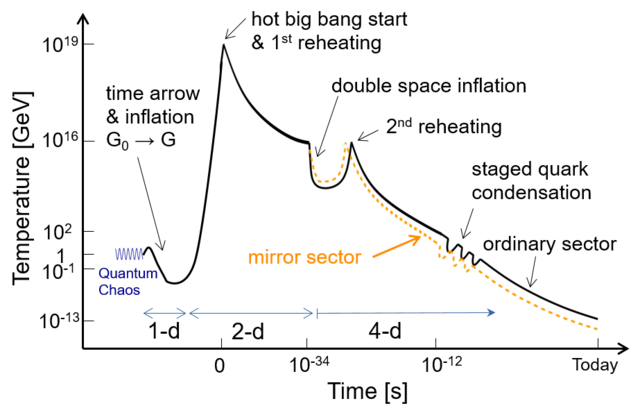
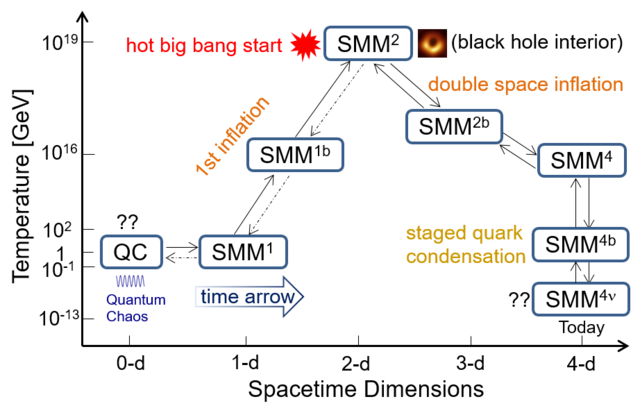
Exploring the Mirror World 9 — First Principles
First principles have always been the revered foundational method of scientific inquiry. Applications of first principles abound across all fields of science. For instance, natural selection serves as the first principle of the theory of evolution in biology. In mathematics, a system of axioms plays the role of first principles for a specific branch—most famously illustrated by Euclid’s fifth, or parallel, postulate.
In physics, first principles are even more indispensable:
-
Classical Mechanics: Built upon Newton’s laws of motion, more modernly expressed as the classical variational or action principle.
-
Classical Electromagnetic Theory: Determined by Maxwell’s equations, which are understood in modern physics through the $U(1)$ gauge symmetry principle.
Over a century ago, Einstein proposed a more general relativistic principle: physical laws should be independent of the choice of any reference frame. For inertial reference frames, this corresponds to Lorentz invariance and led directly to the birth of Special Relativity. Its other cornerstone—the constancy of the speed of light—is actually a natural requirement of spacetime geometry. When accelerating reference frames are considered, Einstein introduced the equivalence principle and established General Relativity, describing gravity as classical spacetime geometry. Similarly, General Relativity can also be derived from the classical variational principle.
The development of quantum theory was more complex, requiring many old concepts to be shattered to make way for new ideas—such as replacing the continuity of classical theory with quantumness or discreteness, characterizing physical states with probability amplitudes, and using operators to calculate observables.
Nevertheless, we still see certain ideas magically passed down from classical to quantum theory. For example, non-relativistic quantum mechanics—namely Schrödinger’s wave equation—can be fully derived from Feynman’s path integral approach. Feynman’s path integral formulation is essentially an upgraded version of the quantum variational principle.
Even modern Quantum Field Theory (QFT) can be derived from the quantum variational principle. The only difference is that the path integrals over spacetime in the non-relativistic case are replaced by integrals over field configurations in spacetime. Furthermore, QFT also respects Lorentz invariance. Modern mathematical fiber bundle theory provides a better understanding of the symmetries in QFT:
The gauge symmetry of QFT is the symmetry of the local or intrinsic fiber space, while the Lorentz symmetry is the symmetry of the corresponding spacetime base manifold. Within the framework of differential geometry, both gauge and Lorentz symmetries can be viewed as metric-preserving holonomy groups of a given manifold.
In the transition from classical to quantum physics, two types of principles have been preserved: the variational or action principle, and holonomy symmetry. A tantalizing idea is to further generalize these two principles to establish a new system of principles for fundamental physics. We can then use this new set of principles—which does not necessarily have to be a single model or theory—to self-consistently understand fundamental physics and cosmology.
Since the establishment of the Standard Model, theoretical physicists have overwhelmingly expected to find a grand unified final theory of everything to unify classical General Relativity and quantum theory. This is typically referred to as quantum gravity, exemplified by popular candidates like String Theory and Loop Quantum Gravity. However, this static interpretation of a unified theory may be misguided.
The progress of science reveals that whether viewed from social history, biological evolution, or cosmic evolution, we live in a dynamically evolving world. A static unified theory is inherently incompatible with such dynamic development. A more reasonable direction should be the pursuit of an open system of first principles to establish a series of self-consistent theories that interpret physics dynamically.
In particular, this dynamic picture tells us that time reversal symmetry must be the very first symmetry of the universe, as well as the first to be broken. Only with the birth of the arrow of time can the universe and all things evolve. It is highly probable that the 4-dimensional spacetime we experience today inflated dimension by dimension.
The Three First Principles of Fundamental Physics
Before diving deeper, we establish three first principles concerning fundamental physics and cosmology:
-
The Quantum Variational Principle: The quantum version of the variational or action principle, based on Feynman’s path integral formulation, provides the foundational concepts and mathematical framework of the theory.
-
The Principle of Observability: The physical world is observable; in other words, observational results must be self-consistent and finite.
-
The Principle of Spacetime Inflation: Spacetime inflates dimension by dimension through dimensional phase transitions, thereby defining matter fields and their interactions.
Principle 1 (The Quantum Variational Principle) provides the methodology for constructing theories. The path integral formulation developed by Feynman tells us how to build a physical theoretical system using the mathematical language of differential geometry, which blends both algebraic and geometric ideas.
Principle 2 (The Principle of Observability) acts as a generalization of Einstein’s principle of relativity. It dictates what we can observe based on the requirement that physical worlds must be observable. Observability means that our observational results must be finite and self-consistent. This naturally introduces symmetries, especially metric-preserving holonomy groups, implying that the symmetries of physical systems arise from the demands of observability.
The first two principles provide sufficient tools to construct a static or single-phase theory. However, they cannot yield the physical content of the system or its phase transition mechanisms. Many past theories, especially in condensed matter physics, merely applied these two principles to a system with a fixed physical content.
Principle 3 (The Principle of Spacetime Inflation) goes further. It not only specifies the physical content (fields and their interactions) of a given spacetime phase, but also reveals the phase transition mechanism of spacetime dimensions. This is what truly and naturally unveils a dynamically evolving universe.
In short:
-
The Quantum Variational Principle provides the physical concepts and mathematical formalism.
-
The Principle of Observability leads to physical constraints and symmetries.
-
The Principle of Spacetime Inflation prescribes the physical content (fields and interactions).
Together, these principles give rise to the latest Mirror Matter Theory discussed previously, specifically the series of Supersymmetric Mirror Models (SMM), offering a comprehensive explanation for mysteries such as the emergence of the arrow of time and the dynamics of the Big Bang.
Feynman’s Legacy and the Path Integral
In my view, Feynman’s greatest contribution was his path integral method—a concept far more vital and profound than the QED work that won him the Nobel Prize. Another great physicist, Hans Bethe, once described Feynman as a “magician” among geniuses, a highly accurate assessment. To me, Feynman is one of the two most admired physicists of the 20th century. The other, of course, is Einstein, whose principle of relativity can be seen as the precursor generalized by our Principle of Observability.
The path integral method dictates that quantum probability amplitudes are determined by the coherent superposition of contributions from all possible configurations. Each field configuration contributes equally to an exponential phase factor. This “democracy principle” represents equal opportunity, not equal outcomes. In fact, in the vast majority of cases, the contributions of different field configurations cancel each other out. Only the contributions near the extremum configuration—which possess maximal symmetry—are the most probable. In the classical limit, this corresponds to the principle of least action in classical physics.
The exponential phase factor in the path integral method is determined by the ratio of the action to Planck’s constant ($h$ or $\hbar$). Planck’s constant determines the discrete quantum nature of the theory, while the action—or the construction of the Lagrangian under a given spacetime manifold—determines the specific physical model of a system.
-
The Principle of Spacetime Inflation dictates what kinds of fields and interactions can enter the action.
-
The Principle of Observability determines which symmetric terms are allowed into the action.
Symmetries and Constraints from Observability
The Principle of Observability requires measurements to satisfy two conditions: finiteness and consistency.
Finiteness (Renormalizability)
In the language of modern QFT, finiteness means renormalizability. This is easy to understand: non-renormalizable terms lead to a divergent action. Due to the exponential phase factor, the contributions of such configurations approach zero, meaning they contribute nothing to the final probability amplitude.
Consistency (Holonomy Groups)
Consistency ensures our measurements are meaningful. Specifically, it yields the inner-product-preserving holonomy group under a given geometry, which is a generalization of the Lorentz group for extended spacetime and the gauge group for local or intrinsic fiber spaces. For example:
-
The holonomy group of an $n$-dimensional Riemannian manifold is $O(n)$.
-
The holonomy group of a $2n$-dimensional Kähler manifold is $U(n)$.
-
The holonomy group of a $2n$-dimensional Calabi-Yau manifold is $SU(n)$.
The Lorentz group $O(1,3)$ in 4D spacetime, alongside the $SU(3)$, $SU(2)$, and $U(1)$ gauge symmetries of the Standard Model, are specific examples of these holonomy groups.
The Principle of Observability also triggers two discrete symmetries in extended spacetime:
-
Orientation Symmetry: The orientation symmetry of the manifold, which manifests as mirror symmetry in the new mirror theory.
-
Supersymmetry: The symmetry connecting fermions and bosons.
Depending on the topology of the manifold, these two symmetries will undergo spontaneous breaking. While we have discussed the significance of mirror symmetry extensively, supersymmetry deserves a few more words. It connects fermions and bosons in spacetimes of two or more dimensions, introducing anti-commuting superspaces and restricting the existence of physical fields in the corresponding spacetime. It also guarantees the positive-definiteness of the Hamiltonian and energy, as well as the direction of the arrow of time.
Spacetime Inflation as a Double Fiber Bundle
The Principle of Spacetime Inflation echoes the philosophical passage from Laozi’s Tao Te Ching: “The Tao produced One; One produced Two; Two produced Three; Three produced all things.” In modern mathematical language, spacetime inflation can be envisioned as the inflation of a double fiber bundle:
-
First, 1D time emerges as the base manifold of the fiber bundle.
-
Then, a 1D tangent fiber space grows exponentially, so the newly generated 2D spacetime becomes the base manifold of a new fiber bundle.
-
Similarly, a 2D tangent fiber space subsequently inflates into a 2D extended space, generating the 4D spacetime we observe today.
Due to the constraints of supersymmetry, besides the 4D extended spacetime, there is a 6-dimensional unextended Calabi-Yau space (corresponding to the Higgs scalar fields generated by the six quark condensates), which cannot inflate further due to the renormalization group theory of scalar fields.
General supersymmetry theory dictates that 1D time can only accommodate a single real scalar field. In 2D spacetime, Majorana fermions and $U(1)$ gauge bosons can exist alongside the scalar field. In 4D spacetime, a wider array of gauge bosons and Dirac fermions becomes possible. Thus, we can construct a series of Supersymmetric Mirror Models (SMM) based on the principle of spacetime inflation.
| Spacetime Dimension | Allowed Fields & Structures | Physical Manifestation |
| 1D (Time) | Single real scalar field | Birth of Time’s Arrow |
| 2D Spacetime | Scalar fields, Majorana fermions, $U(1)$ gauge bosons | Birth of Gravity |
| 4D Spacetime | Gauge bosons, Dirac fermions, leptons (electrons & neutrinos) | Tangent fiber space gives $U(2) \to SU(2) \times U(1)$ |
Notably, 4D spacetime serves as the birthplace of leptons, including electrons and neutrinos. Its corresponding 4-dimensional tangent fiber space yields the $U(2)$ gauge interaction, which splits into the $SU(2)$ weak interaction and the $U(1)$ electromagnetic interaction.
Crucially, there are exactly three independent ways to choose 2 dimensions out of 4 to construct the ordinary and mirror $U(1) \times U(1)’$ interactions, which explains why there are three generations of leptons. Furthermore, 4D geometry cannot simultaneously accommodate two independent $SU(2)$ interactions; as a result, our ordinary world is left-handed, while the mirror world becomes right-handed.
Quarks are defined within the 6-dimensional unextended Calabi-Yau space, which explains why quarks are confined inside hadrons and cannot appear freely in 4D spacetime. This space and its corresponding 6D tangent fiber space also define the $SU(3)$ strong interaction of quarks, as well as the $U(6)$ flavor gauge interaction that breaks after staged quark condensation.
Classical-Quantum Duality
Here, we observe a natural classical-quantum duality. Classical physics (especially gravity) originates from extended spacetime, whereas quantum phenomena are determined by unextended spaces. However, self-consistency requires classical spacetime and quantum space to be tightly intertwined; in fact, they are inseparable—merely two sides of the same physical reality.
Starting from these three first principles, we see how to reconstruct the cornerstone of fundamental physics and cosmology: the framework of Mirror Matter Theory. Yet, Gödel’s incompleteness theorems remind us that a completely closed, omnipotent axiomatic system does not exist, meaning our world is inherently open. We will undoubtedly need to unearth more first principles to continuously deepen our understanding of this physical universe filled with infinite mysteries.
This article is based on the paper:
-
“First principles of consistent physics”
Exploring the Mirror World 10 — Gravity and the Mystery of Black Holes
The study of gravity spans nearly the entire history of modern natural science. As early as the 18th century, within the framework of Newtonian gravity, Pierre-Simon Laplace and John Michell discussed the possibility of celestial bodies so massive that even light could not escape—thus conceiving the earliest notion of a black hole. Shortly after Albert Einstein formulated General Relativity, which describes gravity as spacetime geometry, Karl Schwarzschild derived the first modern black hole solution from Einstein’s field equations.
The Schwarzschild solution is the simplest spherically symmetric, static black hole solution. Yet, it is sufficient to illustrate many of the bizarre properties of black holes. The event horizon—the boundary from which neither matter nor information can escape—has a remarkably simple relationship with the black hole’s mass $M$, given by the horizon radius:
At the horizon, the solution possesses an apparent coordinate singularity that can be removed through a change of coordinates. However, the singularity at the black hole’s center ($r=0$) is physical and cannot be removed by any coordinate transformation. This strongly implies that General Relativity in 4D spacetime breaks down inside the event horizon, and that black holes demand new physics.
The New Physics: A 2D World Inside the Horizon
The required new physics is highly likely the Supersymmetric Mirror Models (SMM) we have been discussing. In the latest Mirror Matter Theory, we utilize three first principles of fundamental physics—the Quantum Variational Principle, the Principle of Observability, and the Principle of Spacetime Inflation—to construct these models and resolve long-standing puzzles in fundamental physics and cosmology.
The new theory posits that gravity is a purely classical phenomenon describing smooth, post-inflationary spacetime geometry. Naturally, its precise formulation depends on the dimensions of the extended spacetime geometry. Conversely, the corresponding quantum phenomena are governed by the gauge theories of the unextended, intrinsic fiber spaces.
For a black hole, this theory provides a very natural realization:
The Spacetime Phase Transition: At the event horizon, spacetime undergoes a phase transition from four dimensions to two dimensions. The interior of a black hole is a genuinely two-dimensional world.
Outside the event horizon, the quantum world is characterized by the 4D Supersymmetric Mirror Model (SMM4b), while the smooth 4D spacetime geometry is governed by General Relativity. SMM4b is simply a mirror extension of the Standard Model, consisting of a parallel sector of nearly identical elementary particles and mirror gauge interactions.
The Interior Physics: Conformal Field Theory and SMM2
In general, 2D spacetime can be described by the gravitational field equation:
Where $R$ is the Ricci curvature scalar, $\Lambda$ is the dark energy (or cosmological constant) induced by scalar fields, and $T$ is the trace of the matter energy-momentum tensor. The condition $T=0$ implies that the matter fields are completely massless.
-
$\Lambda \neq 0$ corresponds to the double space inflation process in the early universe, or the process of a stellar core collapsing into a black hole.
-
$\Lambda = 0$ holds true inside a static black hole interior, yielding $R=0$, meaning the 2D spacetime is Ricci-flat. Consequently, the interior can be described by a simple 2D Conformal Field Theory (CFT).
The interior quantum world is described by the 2D Supersymmetric Mirror Model (SMM2). This model is exceptionally simple—an $N=1$ 2D supersymmetric model composed of massless Majorana fermions and $U(1)$ gauge bosons forming an uncoupled, abelian gauge SUSY multiplet. Because they do not couple, the quantum world inside a black hole behaves as a perfect fluid, perfectly matching the 2D gravitational field equations.
Notably, this perfect fluid, composed of Majorana fermions and gauge bosons (each possessing 2 degrees of freedom, such that $n_b = n_f = 2$), has an effective number of relativistic degrees of freedom:
This value is exactly equal to the central charge $c$ of the Virasoro algebra in 2D Conformal Field Theory.
Reconciling Thermodynamics and the Bekenstein-Hawking Entropy
This simple and elegant picture aligns remarkably well with established black hole physics. We can examine the interior properties—temperature, density, and entropy—from two distinct observational perspectives connected via a conformal transformation. Two physical quantities remain invariant between these frames: the proper energy density $\rho$ and the total entropy $S$.
1. The Remote Outside Observer
To an outside observer, a Schwarzschild black hole has mass $M$ and a horizon radius $r = 2GM$. The black hole interior acts as a 2D conformal torus (with a 1D spatial circumference of $2r$ and a 1D temporal circumference of $2\pi r$), which is equivalent to a 2D horizon surface of area $A = 4\pi r^2$.
The proper energy density can be easily derived as:
(Note: In 2D spacetime, the “volume” is simply the length $2r$). Using the new theory’s degree of freedom $g^* = c = 3$, we can derive the black hole entropy from CFT:
This matches the famous Bekenstein-Hawking entropy exactly.
2. The Internal Observer
To an observer inside the black hole, the thermodynamic properties are derived entirely from the SMM2 model. Through simple momentum integration, the proper energy density and entropy density $s$ are calculated as:
Equating this to the energy density obtained above reveals that the interior temperature $T_{in}$ seen by an internal observer is a constant, sitting roughly at the Planck temperature ($10^{19}\text{ GeV}$). This is fully consistent with the self-consistency requirements of the Supersymmetric Mirror Model.
Due to conformal gravitational redshift, the temperature seen by an outside observer is drastically lower:
This is exactly twice the Hawking radiation temperature ($T_H = 1/4\pi r$), demonstrating that the surface (horizon) characterized by the Hawking temperature is precisely half as cold as the black hole interior.
Resolving Singularities and Paradoxes
Through conformal transformations, we can also compute the black hole size and total entropy experienced by the internal observer (yielding perfect agreement with the Bekenstein-Hawking entropy). For a black hole with a standard solar mass, the size felt by an internal observer is an astonishing $10^{42}$ meters—vastly exceeding the size of our known observable universe ($\sim 10^{27}$ meters).
Stellar Collapse as a Reverse Cosmic Evolution:
[SMM4b] -> [SMM4] -> [SMM2b] -> [SMM2] (Stable 2D Interior Fluid)
This framework offers elegant solutions to several cosmic dilemmas:
-
The Information Paradox: The dimensional phase transition from 4D to 2D near the horizon acts naturally as a firewall, effectively protecting and restructuring the information.
-
The Singularity Problem: The collapse of a star into a black hole is precisely the reverse process of cosmic evolution ($\text{SMM4b} \rightarrow \text{SMM4} \rightarrow \text{SMM2b} \rightarrow \text{SMM2}$). During the collapse, a vast number of particle field degrees of freedom in 4D spacetime are released, continuously softening and heating the stellar core. Ultimately, a spacetime dimensional phase transition occurs, drastically reducing the degrees of freedom and completely avoiding a physical singularity.
It is possible that a definitive upper limit exists for a black hole’s mass (perhaps equal to the mass of the entire universe). If such a supermassive black hole reaches this limit, it would collapse even further back into quantum chaos ($\text{SMM2} \rightarrow \text{SMM1b} \rightarrow \text{SMM1} \rightarrow \text{Quantum Chaos?}$).
This article is based on the following papers:
-
“From neutron and quark stars to black holes”
-
“Truly two-dimensional black holes under dimensional transitions of spacetime”
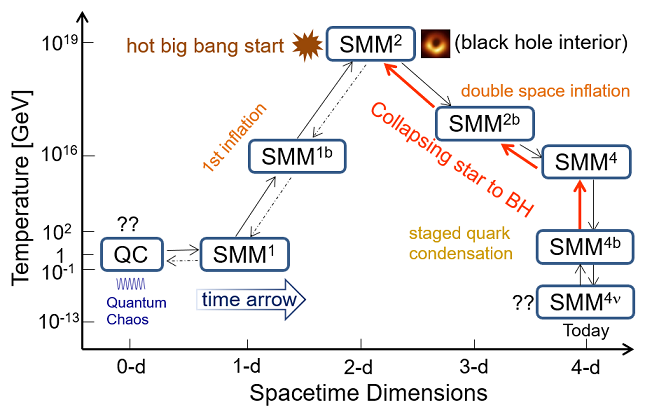
Exploring the Mirror World 11 — The Mystery of CP and Mirror Symmetry Breaking, and the Detection of Invisible Particle Decays
There is a famous theorem in quantum field theory known as the CPT theorem, which states that any Lorentz-covariant local quantum field theory must remain invariant under the combined transformations of charge conjugation ($C$), parity ($P$), and time reversal ($T$).
The non-conservation of parity in weak interactions was first predicted by Tsung-Dao Lee and Chen-Ning Yang in their 1956 paper, and subsequently confirmed by Chien-Shiung Wu’s landmark Cobalt-60 decay experiment. Less than a decade later, CP violation was discovered in the decay of neutral $K^0$ mesons. According to the CPT theorem, this implies that time reversal ($T$) symmetry is also violated.
In the latest Mirror Matter Theory, particularly within the series of Supersymmetric Mirror Models (SMM), we recognize a more fundamental discrete symmetry: mirror symmetry, which is the orientation symmetry of the spacetime manifold. In a one-dimensional time manifold, mirror symmetry is identical to time reversal symmetry. It was the first symmetry to emerge in the universe, and its subsequent breaking gave birth to the arrow of time.
The Four Components of Matter
As the universe evolved to its present state, our 4-dimensional spacetime must obey Lorentz symmetry—represented by the $O(1,3)$ group—in accordance with the first principles discussed earlier. This group contains two $Z_2$ discrete subgroups: mirror symmetry and time reversal symmetry.
Quantized particle fields inherit both symmetries:
-
Mirror Symmetry: Splits the material world into two nearly independent sectors—ordinary and mirror elementary particles, each with their own gauge interactions.
-
Time Reversal Symmetry: Equivalent to CP symmetry (by virtue of the CPT theorem).
In 4D spacetime, an antiparticle can be viewed as a particle moving backward in time. This is why CP symmetry is frequently referred to as the true symmetry between matter and antimatter. Because of this conspicuous matter-antimatter symmetry, physicists long overlooked the possibility of a parallel symmetry between ordinary and mirror matter.
In reality, mirror symmetry and CP symmetry jointly lead to four nearly independent components of matter:
                  ┌── Ordinary Matter
      ┌── Matter ─┤
      │           └── Mirror Matter
World─┤
      │               ┌── Ordinary Antimatter
      └── Antimatter ─┤
                      └── Mirror Antimatter
When the early universe cooled to between $100\text{ GeV}$ and $100\text{ MeV}$, staged quark condensation triggered spontaneous symmetry breaking (including the electroweak and QCD phase transitions). This event simultaneously broke both mirror and CP symmetries. Consequently, a weak mixing or oscillation effect was introduced between matter and antimatter, as well as between ordinary and mirror matter under specific conditions. (Neutrino oscillation is a similar phenomenon, though it corresponds to the breaking of generation symmetry).
Neutral Hadron Oscillations and Shared Parameters
For these ordinary-to-mirror or CP oscillations to occur, the system must be strictly neutral—meaning it cannot carry any gauge charges, including standard electric charge. Therefore, only neutral hadrons can participate in CP and ordinary-mirror oscillations.
This oscillation is a topological effect characterized by two key parameters: the mixing strength between the particles and the mass difference between the two eigenstates. Specifically, oscillations can only occur if the symmetry eigenstates do not perfectly align with the mass eigenstates, and if the mass difference between those mass eigenstates is non-zero.
A natural hypothesis arises: perhaps the breakings of these two discrete symmetries stem from the exact same spontaneous symmetry breaking mechanism, meaning they share identical oscillation parameters. In a specific system—the $K^0$ meson—where both CP and ordinary-mirror oscillations coexist, they are highly likely to share the same parameters.
Fortunately, the CP oscillation effect of the $K^0$ meson has been measured with extreme precision. Globally, its mixing angle is determined to be:
Its two mass eigenstates are known as the long-lived and short-lived kaons ($K^0_L$ and $K^0_S$), with lifetimes precisely measured in the nanosecond range. This yields a remarkably precise $K^0$ mass difference of:
When we apply Mirror Matter Theory to the problems of the neutron lifetime anomaly, dark matter, and the matter-antimatter asymmetry, the required ordinary-mirror oscillation parameters turn out to be strikingly similar to these experimentally measured CP oscillation parameters—differing by a factor of only two to three. This serves as powerful validation for the new mirror theory.
Predicting Invisible Decays Beyond the Standard Model
By assuming that CP and ordinary-mirror oscillations share identical parameters in the $K^0$ meson system, we can leverage precise CP measurements to make remarkably accurate and surprising predictions for the invisible decays of various neutral hadron systems.
What is an Invisible Decay?
Through ordinary-mirror oscillation, an ordinary neutral hadron produced in a high-energy physics experiment can oscillate into a mirror hadron. Because detectors are made entirely of ordinary matter, they cannot interact with or register the mirror hadron. The particle effectively vanishes into thin air—a phenomenon called an invisible decay.
The Standard Model of particle physics can calculate a different kind of invisible decay mode: a neutral hadron decaying into a neutrino-antineutrino pair ($\nu\bar{\nu}$). Because neutrinos interact so infinitesimally with detectors, the hadron also appears to vanish. However, the branching ratios calculated by the Standard Model for these decays (into one or two neutrino pairs) are incredibly tiny—far less than one part in a trillion ($<10^{-12}$) of the total decay width. In other words, the Standard Model’s predicted invisible decays are entirely beyond the reach of current experimental detection.
Despite this, motivated by the hunt for new physics, experimentalists have continuously tried to measure these invisible decays, particularly in short-lived particle systems such as $\pi^0$, $D^0$, and $B^0$. Detecting such a decay would represent a major discovery beyond the Standard Model. However, the new mirror theory predicts very low branching ratios for these specific short-lived systems, explaining why experiments have come up empty so far.
High-Priority Targets for Experimental Discovery
For long-lived neutral hadrons, the new mirror theory predicts highly accessible, measurable branching ratios for invisible decays. For the neutron, this effect manifests as the neutron lifetime anomaly. For the $K^0$ meson system, the predicted branching ratios are well within the capabilities of modern experimental physics:
-
Long-lived Kaon ($K^0_L$): $9.9 \times 10^{-6}$
-
Short-lived Kaon ($K^0_S$): $1.8 \times 10^{-6}$
Unfortunately, no experimental team has ever attempted to measure the invisible decay of the $K^0$ meson. The NA64 collaboration at CERN had planned to conduct this measurement before their accelerator upgrade, but technical glitches and pandemic-related delays stalled the attempt. As CERN’s accelerators steadily resume full operations, NA64 is poised to finally execute this long-awaited experiment.
Another highly promising candidate comes from $\Lambda^0\text{-}\Lambda^{0\prime}$ (lambda to mirror-lambda) oscillations. The $\Lambda^0$ baryon consists of three quarks ($uds$), is only slightly heavier than a neutron, and has a relatively long lifetime ($2.6 \times 10^{-10}\text{ seconds}$). The latest calculations predict its invisible decay branching ratio to be $4.4 \times 10^{-7}$, which is entirely within measurable limits.
Conveniently, all of these hadrons are exceptionally easy to produce. They do not require highest-energy TeV-scale colliders like the Large Hadron Collider (LHC); instead, high-luminosity GeV-scale accelerators are far better suited for these precise measurements.
Predicted Invisible Decay Branching Ratios for Neutral Hadrons
| Neutral Hadron | Quark Content | Predicted Branching Ratio (SMM) | Experimental Outlook |
| $K^0_L$ | $s\bar{d}$ / $d\bar{s}$ | $9.9 \times 10^{-6}$ | High priority; within range for NA64 at CERN |
| $K^0_S$ | $s\bar{d}$ / $d\bar{s}$ | $1.8 \times 10^{-6}$ | Measurable today at BESIII (Beijing) |
| $\Lambda^0$ | $uds$ | $4.4 \times 10^{-7}$ | Feasible at high-luminosity GeV facilities |
| $\Xi^0$ | $uss$ | $3.6 \times 10^{-8}$ | Future target for high-luminosity facilities |
| $D^0$ | $c\bar{u}$ | $1.6 \times 10^{-10}$ | Challenging; requires next-gen factories |
| $B^0$ | $d\bar{b}$ | $4.4 \times 10^{-10}$ | Challenging; requires next-gen factories |
The BESIII spectrometer at the Beijing Electron-Positron Collider (BEPC) is uniquely positioned to pursue this research. While it may not fully cover $K^0_L$ under current conditions, it is perfectly optimized for the short-lived $K^0_S$ meson, where its sensitivity precisely matches the $10^{-6}$ branching ratio predicted by the new model. Furthermore, China’s next-generation high-energy facility, the Super Tau Charm Facility (STCF), will undoubtedly provide even more precise measurements for both $K^0$ and $\Lambda^0$ invisible decays, though its construction and commissioning will take at least a decade.
In the near future, many low-energy, high-luminosity accelerators may shift their focus toward measuring these precise invisible decay rates predicted by the new theory. Advancements in detection technology will eventually allow us to measure even weaker neutral hadron oscillations, particularly those containing heavier quarks. These empirical measurements will ultimately pin down the ordinary-mirror mixing parameters for all quarks, providing a definitive, comprehensive test of Mirror Matter Theory.
This article is based on the paper:
-
“Invisible decays of neutral hadrons”
Exploring the Mirror World 12 — Future Outlook
As a new research direction, the new Mirror Matter Theory requires significant refinement and development. In particular, its mathematical foundations and rigor remain to be established, and the associated mathematical techniques need to be expanded. Advances in frontier theoretical physics over recent decades—especially work in topological quantum field theory, string theory, and quantum gravity—must be integrated into this new theoretical framework.
Most importantly, the neutral hadron oscillation effects predicted by the new theory urgently require further experimental verification, and targeted astronomical observations and simulations must be comprehensively launched within this new framework. Below, I offer a few words to mathematicians, theoretical physicists, and experimentalists/astronomers alike, serving as a modest contribution to stimulate further discussion.
A Message to Mathematicians
Hamilton’s Ricci flow could very well be a powerful tool for describing the spacetime dimensional phase transitions required by the Principle of Spacetime Inflation. It also appears to be the classical dual to the renormalization group flow (RG flow) in quantum field theory; that is, while the RG flow describes the phase transitions of fields corresponding to the intrinsic quantum space, the Ricci flow describes the phase transitions of the corresponding extended classical spacetime.
A tantalizing idea is to apply the techniques of Ricci flow—or geometric flows more broadly—to fiber bundle theory (effectively incorporating phase transition dynamics) and explore the duality between the base manifold and the fiber space. This could establish a dynamic differential geometry as the mathematical foundation for the new mirror theory.
The new mirror theory draws upon an incredibly broad and cutting-edge mathematical foundation:
-
Differential Geometry: Forms the mathematical basis for Feynman’s path integral formulation of the quantum action principle (and modern QFT).
-
Probability and Measure Theory: Essential for fully grasping the concept of probability amplitudes and the functional integration over fields.
-
Group Theory, Abstract Algebra, Algebraic Topology, Algebraic Geometry, & Category Theory: Provide the mathematical underpinning for the constraints and symmetries introduced by the Principle of Observability.
-
Number Theory: The discrete nature demanded by quantum mechanics (non-zero Planck’s constant) and the randomness inherent in probability amplitudes (which are closely tied to the distribution of prime numbers) hint at a deep connection to number theory.
Ultimately, the new mirror theory is the child of three first principles. Its complete mathematical foundation will likely require an organic integration of all these disparate fields—a grand fusion of the most advanced ideas and techniques from algebra, geometry, analysis, probability/measure theory, and even number theory.
A Message to Theoretical Physicists
Gravity and quantum mechanics exist in a relationship of duality—they are two sides of the same physical reality. A static theory of everything is simply non-viable. Integrating the three first principles of the new mirror theory may be the exact rejuvenation that past theoretical efforts desperately need. For instance, String Theory is likely the mathematical tool tailored for a single-phase symmetric mirror model at a given spacetime dimension, while theories like Loop Quantum Gravity (LQG) might provide an excellent means to discuss the phase transitions between spacetime dimensions themselves.
Classical spacetime is the bedrock of measurement, and gravity is a purely classical phenomenon within that arena. The gauge groups and three generations of elementary particles in the four-dimensional Standard Model are strictly dictated by the self-consistency of the new theory. Supersymmetry (SUSY) does not introduce redundant degrees of freedom; rather, it corresponds to already existing, albeit broken, symmetries:
-
Gauge-SUSY: Symmetries between gauge bosons and matter fermions.
-
Chiral-SUSY: Symmetries between Higgs-like scalar particles (acting as fermion condensates) and neutrino-like singlets (which lack gauge coupling).
It is CP symmetry (or equivalently, time reversal symmetry) that duplicates elementary particles into matter and antimatter degrees of freedom. It is mirror symmetry that duplicates them once more into ordinary and mirror sectors. This culminates in four almost entirely decoupled particle sectors, which mathematically originate from the four non-simply connected components of the 4D Lorentz group $O(1,3)$.
Consequently, the topological properties of quantum field theory are extraordinarily vital for this new physics. Advancing QFT further will necessitate adopting a multitude of mathematical breakthroughs, especially topological techniques like the transitions between Ricci flow and RG flow.
A Message to Experimentalists and Astronomers
The universal neutral hadron oscillation effect predicted by the new mirror theory is now fully verifiable in the laboratory. Existing experimental technologies are sufficiently mature to test the unique predictions of this theory and extract precise measurements of the model’s parameters.
1. Laboratory and Particle Physics
-
Neutron Physics: The detection of the neutron lifetime anomaly can be carried out across various sizes of ultracold neutron magnetic traps; in narrow magnetic traps, the anomalous discrepancy can easily exceed hundreds of seconds. Furthermore, the resonant ordinary-mirror neutron ($n\text{-}n’$) oscillation effect can be observed in ultra-strong magnetic fields (on the order of 100 T), manifesting as a neutron disappearance rate as high as 25%.
-
Invisible Decays: For particle experimentalists, the oscillation effects of other neutral mesons and baryons reveal themselves as invisible decays. The prime candidates for these measurements include the branching ratios for:
-
$(K^0_L \rightarrow K^{0\prime}_L)$: $9.9 \times 10^{-6}$
-
$(K^0_S \rightarrow K^{0\prime}_S)$: $1.8 \times 10^{-6}$
-
$(\Lambda^0 \rightarrow \Lambda^{0\prime})$: $4.4 \times 10^{-7}$
Oscillations involving heavier quarks (such as $D^0$ and $B^0$) may also become measurable in the not-too-distant future, ultimately helping us pin down the ordinary-mirror mixing parameters for all quarks.
-
2. Cosmology and Astronomy
-
Cosmological Frameworks: Integrating the new mirror theory into cosmological models like $\Lambda\text{CDM}$ will enable a better, quantitative grasp of early universe evolution and large-scale structure formation.
-
Stellar Evolution: Incorporating the $n\text{-}n’$ oscillation effect into stellar evolution models (including supernova simulations) is essential to resolving many anomalies surrounding the late-stage evolution of massive stars.
-
Observational Targets: Measuring ultra-high-energy cosmic rays (UHECRs) could be an excellent way to spot mirror astronomical bodies, and observing a more pronounced second GZK cutoff would help determine the temperature of mirror matter in the universe. Gravitational lensing can map the spatial distribution of mirror matter. If a mirror celestial body (such as a mirror planet) exists in our cosmic neighborhood, it would be entirely undetectable by electromagnetic means, but we would definitively “feel” its presence through anomalous gravitational signatures.
Exploring the Mirror World 13 — Mirror Civilizations
Here, let’s use the new Mirror Matter Theory to indulge in a major brainstorming session. The core idea originated about three years ago, during the early development of my theory, from a discussion with one of my daughters, who loves fantasy novels. Having recently learned that science fiction author Yang Jiandong is interested in my theory, his attention has finally prompted the release of this imaginative post.
According to the new Mirror Matter Theory, the dark matter in our “invisible” universe is mirror matter made of mirror particles. Current observations indicate that dark matter, or mirror matter, is far more abundant than the ordinary matter we can “see.” Depending on whether one assumes cosmic isotropy or anisotropy, this ratio is roughly 5 to 10 times greater. This might imply that our “invisible” mirror world had a much higher probability of evolving advanced civilizations first compared to our visible ordinary world.
The new theory and cosmological observations also tell us that the temperatures of these two worlds are different—the mirror world is much colder than ours. Because the evolution of the universe since the hot Big Bang has been a cooling process, the direction of evolution corresponds to a drop in temperature. This means that at any given moment, the cooler mirror world is very likely at a more advanced stage of evolution. Combining this with the aforementioned larger material bulk of the mirror world, it becomes highly reasonable to hypothesize the existence of a mirror civilization far more advanced than our own human civilization. If any science fiction author wishes to write on this topic, I would be delighted to assist.
The Feasibility of Mirror Life
Before diving deeper into this thought experiment, let’s re-examine the plausibility of mirror civilizations. We know that the emergence of life in the ordinary world (let alone civilization) demands incredibly stringent physical and chemical parameters, which has even led to the popularity of the anthropic principle. If the physical parameters of a parallel world differed by even one percent, it would be impossible to imagine how life there could ever be born.
Fortunately, the new theory dictates that the vast majority of parameters in the mirror world (such as particle masses) are nearly identical to those in the ordinary world, with differences not exceeding roughly one part in a hundred trillion ($10^{-14}$). This guarantees that the physical and chemical processes driving the evolution of life in the mirror world should be highly analogous.
However, the cooler mirror world likely possessed a very different primordial elemental abundance, particularly the initial abundances of light elements like mirror hydrogen and helium. This would cause the evolution of mirror stars to differ slightly from ordinary stars. Unfortunately, no one has performed simulation calculations in this area yet—which leaves plenty of creative room for science fiction writers to explore.
The Reality of Phantom Intersections
Let us first clarify a fundamental concept. Most interactions in our ordinary world—such as “seeing,” “observing,” “touching,” or “colliding”—are mediated via the electromagnetic interaction. In the mirror world, these exact interactions are mediated via an entirely independent mirror electromagnetic interaction. Consequently, objects from the two worlds can only perceive things belonging to their own respective worlds; they can neither see nor touch objects from the other world.
The only thing they mutually experience is Einstein’s gravity. Yet gravity is incredibly weak and only becomes prominent at astronomical scales. Therefore, if an ordinary biological organism and a mirror biological organism were to cross paths, they could neither see nor perceive each other. They would be completely transparent to one another, literally passing right through each other’s bodies without sensing a thing.
Ordinary Sector ──[Electromagnetism]──> Only interacts with Ordinary Matter
                                \
                                 ──[Gravity]──> Shared Experience <──[Gravity]──
                                /
Mirror Sector   ──[Mirror EM]──────────> Only interacts with Mirror Matter
Even if civilizations exist in both worlds, communication between them would be exceptionally difficult. One possibility is that a civilization becomes so ultra-advanced that its mastery over gravity reaches an incredibly micro-refined level. To grasp the difficulty of this, consider that humanity has only recently built two massive gravitational wave detectors (LIGO and VIRGO), which can only detect the colossal collisions and mergers between the densest objects in the universe (black holes and neutron stars). However, if a civilization perfectly masters gravitational lensing, they could, in principle, perceive the mass and shape of objects in the other world.
Communicating via Neutron Oscillations
A more feasible method of communication is through the neutral particle oscillation effects predicted by the new theory, with the most practical candidate being neutron oscillation.
For example, we could “write down” our thoughts using ordinary neutrons, which would then encode information and transform into mirror neutrons via oscillation. A nearby mirror civilization could then detect and “read” our message. However, because neutrons (and likewise, mirror neutrons) have a lifetime of only about 15 minutes, this form of communication is strictly suited for real-time, instantaneous messaging.
Precisely because inter-world communication and physical interaction are so difficult, even a massive developmental gap between the two civilizations would make it highly unlikely for one to completely crush the other. This is reassuring news for humanity.
As established at the beginning of our discussion, a mirror civilization far more advanced than ours likely coexists in this universe. Yet, the new theory reassures us that even if they are thousands or millions of years ahead of us, they can hardly exert a crushing, existential threat over our world. Perhaps one day in the future, we will finally wake up and pay attention to the neutron-oscillation messages sent to us by a mirror civilization. Until then, this fundamental isolation and cosmic loneliness also guarantee that our fragile human race remains psychologically secure.
Exploring the Mirror World 14 — What Exactly Are Mirror Symmetry and Supersymmetry?
This article is based on the paper: “Mirror symmetry for new physics beyond the Standard Model in 4D spacetime”, published in Symmetry, 15(7), 1415 (2023). (Earlier explorations can be found in the unpublished preprints: “Dark energy and spontaneous mirror symmetry breaking” and “Supersymmetric mirror models and dimensional evolution of spacetime”).
Below, we will use accessible, popular-science language to re-examine the most critical concept in Mirror Matter Theory—mirror symmetry—and re-interpret the highly popular concept of supersymmetry (SUSY). In particular, we will unveil the profound geometric origin of mirror symmetry and demonstrate how these discrete symmetries, much like matter-antimatter (or time reversal) symmetry, expand or interlink our known universe of elementary particles.
The Deep Geometry of the Lorentz Group
Let us first re-examine Lorentz invariance in four-dimensional spacetime—a symmetry first recognized by Albert Einstein in his theory of Special Relativity, which later became a foundational cornerstone of modern Quantum Field Theory (QFT).
From a geometric perspective, Lorentz invariance is described by the pseudo-orthogonal group $O(1,3)$, which is a natural requirement of a 4D pseudo-Riemannian manifold. In the language of differential geometry, it acts as the metric-preserving holonomy group that ensures physical laws remain invariant across spacetime. This group includes continuous symmetries like rotations in 3D space, as well as Lorentz boosts—which act like rotations involving the time dimension across different inertial reference frames.
Crucially, it also encompasses two independent discrete symmetries:
-
Spatial Inversion / Parity ($P$)
-
Time Reversal ($T$)
These two discrete symmetries partition the Lorentz group $O(1,3)$ into four topologically inequivalent components. In physics, these are standardly denoted by the set $\{1, P, T, PT\}$, where $1$ represents the component containing the group identity element and $PT$ represents simultaneous parity and time reversal.
From Topology to Mirror Matter
While the $\{1, P, T, PT\}$ notation is heavily favored by physicists, mathematics offers a much more natural decomposition based on the universal properties of orthogonal groups:
Here, $O(1) = Z_2$ represents the simplest binary discrete symmetry group, characterizing the orientation symmetry of spacetime. This is intimately linked to mirror symmetry.
Generally, manifolds possess two orientations—for example, a sphere has an “inward” and an “outward” orientation. Even a Möbius strip, which globally has only one orientation, possesses two distinct orientations locally that are globally linked by its unique topology. When treating the Lorentz group $O(1,3)$ as a matrix, its determinant yields two discrete values: $\pm 1$. These values correspond precisely to transformations between these two opposite orientations.
By utilizing this discrete orientation symmetry alongside time reversal $T$, we can divide the Lorentz group into four components. The component containing the identity element is known as the proper, orthochronous Lorentz group, denoted as $SO^+(1,3)$. This proper subgroup is strictly orientation-preserving, meaning its determinant is always $+1$.
While the Lorentz group $O(1,3)$ is thoroughly understood from a purely relativistic or group-theoretic standpoint, its implications within traditional QFT have remained obscured. This is because traditional QFT lacks the mathematical tools to handle orientation symmetry. QFT relies on the framework of fiber bundles, where spacetime acts merely as the base manifold. For fermions like electrons and quarks, traditional QFT utilizes the language of Dirac gamma matrices—all of which have a determinant of $+1$. Consequently, traditional QFT implicitly operates entirely within a single, identical spacetime orientation.
Why Basic Particles Must Double
Is it possible that a distinct set of elementary particles exists with the exact opposite spacetime orientation?
In the 1960s, Eugene Wigner first recognized in his summer lecture notes that the discrete symmetries of the Lorentz group should double the known particle states. Steven Weinberg later provided an even deeper discussion of this in his renowned textbook The Quantum Theory of Fields.
From the perspective of group theory, the logic is elegant: elementary particles correspond to the irreducible representations of the Lorentz group. Therefore, every discrete symmetry of the Lorentz group must double the total number of particle states.
-
Time Reversal $T$ (or $CP$): Doubles the particle count by dictating the existence of matter and antimatter.
-
Orientation Symmetry: Naturally introduces another parallel set of anti-oriented elementary particles—the mirror particles proposed in Mirror Matter Theory.
Note on Parity ($P$): The parity operator $P$ in standard QFT is not the most fundamental operator and is orientation-preserving ($\det = +1$), meaning it is not the orientation or mirror symmetry discussed here. However, this discrete symmetry still adds degrees of freedom by dividing particles into left-handed and right-handed states, known as chirality.
Just as the Lorentz group consists of four discrete components, the spectrum of elementary particles must also be divided into four sectors: ordinary particles, antiparticles, mirror particles, and mirror antiparticles. Traditional QFT only describes the first two.
String Theory and the Inward-Outward Duality
To introduce local orientation symmetry (mirror symmetry) into quantum field theory, we look to the fact that local internal spaces in field theory are unitary spaces (a type of complex space). Complex conjugation, as a binary symmetry, must be intrinsically linked to mirror symmetry. In mathematics, the analytical descriptions of a complex space and its conjugate space are known as holomorphic and anti-holomorphic structures, which correspond closely to mirror symmetry.
Geometrically, the most natural orientation symmetry for an internal space is the inward $\leftrightarrow$ outward duality. This immediately bridges mirror symmetry with superstring theory.
String theory provides a magnificent mathematical toolkit for deepening our understanding of Mirror Matter Theory. At its core, string theory is defined on a 2D worldsheet (a 1-dimensional complex space), which naturally introduces a universal $U(1)$ gauge and complex structure.
Specifically, string theory features a T-duality symmetry ($R \leftrightarrow 1/R$) regarding the compactification radius of the string. Instead of viewing T-duality as a mapping between entirely different theories, Mirror Matter Theory interprets it as the symmetry between ordinary and mirror particles—a duality between two particle worlds. This duality seamlessly connects internal parity (on the worldsheet), internal chiral transformations (in the target space), and holomorphic/anti-holomorphic duality.
The higher-dimensional generalization of T-duality is Calabi-Yau mirror symmetry (CY mirror symmetry). The SYZ conjecture, proposed by Andrew Strominger, Shing-Tung Yau, and Eric Zaslow in 1996, explicitly connects T-duality to CY mirror symmetry. The complex 3-dimensional (real 6-dimensional) CY mirror symmetry is precisely the implementation of mirror symmetry within the space governing quarks and strong interactions.
Today, CY mirror symmetry is a monumental topic in mathematics, especially after Philip Candelas, Xenia de la Ossa, Paul Green, and Linda Parkes used it in 1991 to solve a long-standing problem in algebraic geometry. The sheer mathematical complexity of CY mirror symmetry is likely why traditional QFT failed to develop its mirror extension sooner. String theory is an exceptional mathematical tool, but its true physical significance only becomes clear when its mathematical fruits are placed within the framework of Mirror Matter Theory.
We can visualize mirror symmetry through a simple analogy: ordinary and mirror particles share the exact same spacetime stage. Imagine extended spacetime as a single sheet of paper. Ants crawling on the top side of the paper represent ordinary particles, while ants crawling on the bottom side represent mirror particles. They can occupy the exact same coordinate on the paper but can never truly “meet” via gauge interactions, though both can warp and feel the curvature of the paper itself via gravity.
Reimagining Supersymmetry: No New Particles
Supersymmetry (SUSY) is another profound discrete symmetry. As an emergent symmetry in spacetimes of two or more dimensions under the Principle of Spacetime Inflation, it bridges fermions and bosons.
Superstring theory and other popular supersymmetric models harbor a critical misconception: they constantly attempt to invent a completely new, undiscovered zoo of “superpartners” (primarily to explain dark matter). This is the fundamental reason why these models have failed. The fact that the Large Hadron Collider (LHC) in Geneva has consistently failed to find any of these predicted superparticles is definitive proof of this systemic error.
In reality, the new particles that actually demand discovery are the mirror particles required by mirror symmetry (which constitute the dark matter world). Supersymmetry, as a discrete symmetry, does double the particle spectrum, but it does not create a brand-new set of hypothetical particles; rather, it is a symmetry existing between our already known fundamental fermions and bosons. Supersymmetry has been right in front of us all along, but it is so heavily broken that we confront it daily without realizing it.
One of the first to recognize this possibility was the great physicist Yoichiro Nambu (2008 Nobel Laureate). His concept of quasi-supersymmetry (quasi-SUSY) has been extended into the framework of Mirror Matter Theory. In this new paradigm, our known quarks and leptons are actually the supersymmetric partners of the gauge bosons (such as the photon).
Solving the Degree of Freedom Puzzle
An immediate problem arises with this new interpretation: there appear to be far too many fermion degrees of freedom (quarks and leptons) compared to gauge bosons for supersymmetry to hold.
In our ordinary matter sector, the counts are as follows:
-
Three generations of quarks: 72 degrees of freedom
-
Charged leptons: 12 degrees of freedom
-
Neutrinos (strictly left-handed): 6 degrees of freedom
-
Total Fermion Degrees of Freedom: 90
In contrast, the gauge bosons consist of:
-
Strong interaction gluons: 16 degrees of freedom
-
Massive weak interaction $W^\pm$ and $Z$ bosons: 9 degrees of freedom
-
Electromagnetic photons: 2 degrees of freedom
-
Total Gauge Boson Degrees of Freedom: 27
Where are the missing 63 degrees of freedom?
In Mirror Matter Theory, the $U(6)$ flavor gauge symmetry among the six quarks is broken following the spontaneous symmetry breaking of the weak $SU(2)$ gauge interaction. This breaking triggers the generation of pseudo-Nambu-Goldstone bosons, which possess exactly 63 degrees of freedom! Thus, the “Standard Model” particles after spontaneous symmetry breaking perfectly satisfy a pseudo-supersymmetry (pseudo-SUSY). From another perspective, this requirement is highly likely the fundamental reason why elementary particles have exactly three generations and why neutrinos are degenerate—without these conditions, this newly understood supersymmetry could not be satisfied.
Supersymmetry is also the origin of particle spin, serving as the bridge between different spin values. It self-consistently dictates which sets of elementary particles emerge under different spacetime dimensions. For instance, in 2D spacetime, supersymmetry guarantees the coexistence of Majorana fermions and $U(1)$ bosons. The magnificent spectrum of elementary particles that builds our 4D universe is similarly dictated by the self-consistency of supersymmetry.
Correctly understanding mirror symmetry and supersymmetry is the absolute key to unlocking Mirror Matter Theory (and they are the namesake origin for the Supersymmetric Mirror Models: SMM2, SMM2b, SMM4, SMM4b). Together, these two discrete symmetries form the essential skeletal framework of the elementary particle system in our universe. Combined with the mathematical machinery developed by string theory, we are well on our way to tearing away the shroud of mystery surrounding the mirror universe.
Exploring the Mirror World 15 — Superstring Theory and Mirror Theory
Superstring theory has a long and storied history. Originating in the late 1960s, it was initially conceived to explain the strong interactions of quarks. However, the concurrent development of $SU(3)$ gauge theory—which elegantly explained the strong force through asymptotic freedom—quickly won over the physics community, cementing itself as a core pillar of the Standard Model. As a result, string theory faded into the background as a short-lived curiosity.
Nevertheless, a few physicists suspected that superstring theory could hold the key to a grander prize: a quantum theory of gravity capable of unifying General Relativity with the Standard Model. Two lonely warriors, John Schwarz and Michael Green, persevered through this isolation. In 1984, they successfully resolved the anomaly issues plaguing the framework, igniting the First Superstring Revolution.
A Lesson in Perseverance: During string theory’s dark ages, John Schwarz failed to secure tenure at Princeton and had to spend over a decade as a research associate (effectively a perpetual postdoc) at Caltech. Naturally, once he achieved international fame, Caltech immediately granted him a full professorship.
A decade of relative calm followed until the Second Superstring Revolution elevated the framework to new heights. Edward Witten proposed M-Theory, a grand framework unifying the five known superstring models, while Joseph Polchinski developed the rich physics of D-branes. This momentum culminated in late 1997 with Juan Maldacena’s landmark paper on AdS/CFT duality—a concrete realization of the holographic gauge-gravity duality, marking the absolute zenith of superstring theory.
Since then, superstring theory has faced a steady decline. It ran into immediate compatibility issues with the observed accelerated expansion of the universe (which requires a positive cosmological constant or dark energy). This was further complicated by the existential confusion of the string theory “landscape.” The final straw, however, was the Large Hadron Collider’s (LHC) failure to find standard supersymmetry.
Critiques mounted from both outside and within the community. Notable counter-arguments included The Trouble With Physics by Loop Quantum Gravity pioneer Lee Smolin, and Not Even Wrong by Columbia University’s Peter Woit. Once again, string theory found itself in a trough. Is superstring theory truly just a beautiful piece of mathematics detached from our physical universe?
This article aims to answer that question using accessible language. We will explore how the magical mathematical toolkit of superstrings is intrinsically intertwined with Mirror Matter Theory. The core conclusions are based on the paper: “Mirror symmetry for new physics beyond the Standard Model in 4D spacetime”, published in Symmetry, 15(7), 1415 (2023).
Redefining Spacetime and Critical Dimensions
In our previous discussion (What Exactly Are Mirror Symmetry and Supersymmetry?), we saw how Mirror Matter Theory unearths the complete physical meaning of Lorentz symmetry under quantum field theory. Mirror symmetry, operating as the local orientation symmetry of the extended 4D spacetime manifold, mandates the existence of a parallel set of mirror particles and mirror gauge interactions. This mirror sector is a near-perfect copy of our familiar ordinary Standard Model sector, and both worlds share the exact same spacetime stage.
The mathematical discoveries of T-duality ($R \leftrightarrow 1/R$) and Calabi-Yau mirror symmetry are concrete, lower-dimensional manifestations of this deep mirror symmetry. Yet, the relationship between Mirror Matter Theory and string theory goes much deeper.
A universally recognized conclusion in superstring theory is that the universe must be 10-dimensional to maintain mathematical consistency. This 10D framework is called a critical dimension. In reality, superstring theory possesses two critical dimensions where it can maintain absolute consistency:
To preserve the consistency of superstring theory, one must eliminate its conformal anomalies, which is achieved by introducing a system of Faddeev–Popov ghost fields:
-
In 2D spacetime, canceling the anomaly requires introducing two ghost fields with spins $1/2$ and $1$.
-
In 10D spacetime, canceling the anomaly requires introducing ghost fields with spins $3/2$ and $2$.
These are the only two scenarios where superstring theory remains naturally consistent.
The Principle of Spacetime Inflation in Mirror Matter Theory states that the extended dimensions of our universe inflated sequentially—emerging step-by-step from 0D, 1D, 2D, to our current 4D universe. The holographic principle (including gauge-gravity duality) describes this dimensional evolution as a holographic phase transition. Superstring theory serves as the ideal mathematical engine to describe this process from 2D upward.
The 2D Models: SMM2 and SMM2b
Two dimensions represent a unique geometric threshold: supersymmetry requires at least a 2D world for particles to possess spin, which is where rich physical phenomena begin to emerge. String theory, at its core, is a universal mathematical framework for a quantum field theory equipped with complex structures—put simply, it is a complex field theory.
Quantum field theory and string theory can both be elegantly translated into the language of differential geometry’s fiber bundles:
The Agricultural Analogy: Think of a fiber bundle as a field of leeks. The base manifold is the ground, and the fiber space represents the individual leeks growing out of it.
In this language, extended spacetime acts as the base manifold (or its unfolded part). The internal space or unextended degrees of freedom of the field theory correspond to the fiber space (or the compactified, curled-up parts of the base manifold).
The 2D Supersymmetric Mirror Models (SMM2 and SMM2b) map directly onto the simplest configuration of string theory: an extended 2D spacetime (a base manifold governed by Ricci-flat 2D gravity) matched with a 2D internal space (the string worldsheet).
-
SMM2 corresponds to the simplest $U(1)$ supersymmetric gauge theory, containing massless Majorana fermions and $U(1)$ gauge bosons. Together, they form an uncoupled perfect fluid that flawlessly describes the microscopic physics of a Schwarzschild black hole interior [Int. J. Mod. Phys. D 30, 2142020 (2021)].
-
SMM2b describes a dynamical theory of spontaneous symmetry breaking, where the Majorana fermions condense into two chiral, holomorphic/anti-holomorphic scalar fields. This yields a simple $N=(1,1)$ supersymmetry model that captures the further extension of the curled-up 2D internal space, perfectly modeling early universe cosmic inflation or the structural collapse of a black hole.
Solving the 4D vs. 10D Discrepancy
If string theory demands a critical dimension of 10D, why do we experience a 4-dimensional universe today?
The answer is remarkably self-consistent. The base manifold of our universe is indeed fundamentally 10-dimensional, but only 4 dimensions have successfully extended. Two of these extended spatial dimensions were generated via inflation driven by the two scalar fields mentioned above. Quantum field theory dictates that interacting scalar field theories (such as $\phi^4$ theory) are non-renormalizable in spacetimes higher than four dimensions. In other words, the base manifold can mathematically extend to a maximum of 4D; any further expansion breaks self-consistency.
Consequently, the remaining 6 dimensions of the base manifold must remain tightly curled up (compactified). As we will see, this geometrical constraint is the physical origin of quark confinement.
Early hints of a 10D universe appeared during the birth of the Standard Model. In 1974, Howard Georgi and Sheldon Glashow proposed the $SU(5)$ Grand Unified Theory (GUT) [Phys. Rev. Lett. 32, 438, 1974], relies on the intriguing mathematical decomposition:
The decomposed groups represent the exact gauge groups of the Standard Model ($SU(3)$ for the strong force, $SU(2)$ for the weak force, and $U(1)$ for electromagnetism). Crucially, $SU(5)$ can be viewed geometrically as the holonomy group of a 10-dimensional Calabi-Yau (CY) manifold.
In 2005, John Baez re-emphasized the profound significance of this 10-dimensional space for the Standard Model’s symmetry groups, demonstrating that this decomposition perfectly constructs the representations for exactly one generation of fermions [arXiv:hep-th/0511086]. However, our universe contains three generations of fermions, and the weak interaction is famously chiral (meaning $SU(2)$ acts strictly on left-handed states). What was the missing piece of the puzzle?
Heterotic Strings and the SMM4 Model
The answer lies within an early milestone of the First Superstring Revolution. In 1985, David Gross, Jeffrey Harvey, Emil Martinec, and Ryan Rohm formulated Heterotic String Theory [Phys. Rev. Lett. 54, 502, 1985]. By blending a 26-dimensional left-moving bosonic string with a 10-dimensional right-moving superstring, and compactifying the extra 16 dimensions, they derived a purely left-handed heterotic string theory.
Within the framework of Mirror Matter Theory, the profound physical significance of this construction becomes clear:
The left-handed heterotic string corresponds to our ordinary particle world, while the right-handed heterotic string governs the mirror world.
Taking the left-handed sector as our example, the shared 10 dimensions form the base manifold, while the extra 16 dimensions of the bosonic string function as the left-handed fiber space. Renormalizability demands that the 10D base manifold split into $4\text{D} + 6\text{D}$.
               ┌── 4D Extended Spacetime ──> Leptons (Propagate Freely)
10D Base ──────┤
               └── 6D Compactified CY ─────> Quarks (Confined to 6D Space)
The universal $U(1)$ gauge structure corresponds to the hypercharge $U_Y(1)$ associated with electromagnetism. The 6D compactified Calabi-Yau space explicitly defines the $SU(3)$ strong interaction for quarks.
Concurrently, the left-handed weak interaction $SU_L(2)$ originates from the 16-dimensional left-handed fiber space. This 16D space initially yields a massive $SU_L(8)$ gauge group, which must decompose in accordance with the base manifold split. The component mapping to the 4D extended spacetime provides the familiar weak interaction $SU_L(2)$, while the component mapping to the 6D quark space—$SU_L(6)$—breaks due to anomalies.
At the ultra-high-energy limit (the SMM4 model), $SU_L(6)$ breaks down into the standard isospin gauge group $SU_I(2)$ for $u$ and $d$ quarks. In this high-energy supersymmetric model, each sector contains exactly one generation of fermions with 30 degrees of freedom (matching the Baez representation). Notably, neutrinos are shared between the two sectors: left-handed neutrinos participate in the ordinary weak interaction, while right-handed neutrinos operate within the right-handed mirror sector.
Low-Energy Evolution: SMM4b and the Standard Model
As the universe cools, spontaneous symmetry breaking transitions the high-energy SMM4 model into the low-energy SMM4b model. Elementary particles acquire mass, and the fermion spectrum expands from one generation to three generations (because the three extended spatial dimensions correspond to three distinct complexified tangent spaces). Spacetime finishes unfolding into a fully extended 4D arena.
Following this transition, the original $SU_L(6)$ quark space group shifts into a global flavor symmetry group for the 6 quark flavors. Through chiral symmetry breaking, this manifests as a series of approximate global conservation laws (isospin, baryon number, and individual flavor numbers for $t, b, c, s$).
With this final piece, we successfully recover the modern Standard Model of particle physics. Specifically, the six Higgs scalar fields (which correspond directly to the 6 unextended dimensions of the base manifold) formed via the condensation of the 6 quark flavors—most notably the top quark condensate—provide the mass-generation mechanism for all elementary particles.
Conclusion
By uniting superstring theory with Mirror Matter Theory, we arrive at a remarkably natural, geometric explanation for the deepest anomalies in particle physics:
-
The geometric origin of the Standard Model’s gauge interactions.
-
The source of chirality in the weak interaction.
-
The reason why nature selected exactly three generations of fermions.
-
The topological inevitability of quark confinement.
Rather than being a beautiful piece of redundant mathematics, string theory provides the exact structural blueprint required by Mirror Matter Theory. Further advancements in string mathematics will undoubtedly solidify the foundations of the mirror universe, moving us closer to an ultimate, verifiable understanding of reality.
Exploring the Mirror World 16 — Chiral Pairing Condensation and High-Temperature Superconductivity
This article serves as a special spin-off edition of the Exploring the Mirror World series—a beautiful case of serendipity. Its core inspiration stems directly from the concept of chiral condensation within Mirror Matter Theory.
The traditional theory of superconductivity, established by John Bardeen, Leon Cooper, and John Robert Schrieffer in 1957 (the BCS theory), elegantly explains conventional superconductors. However, unconventional superconductors—specifically the two major classes of high-temperature superconductors, copper-based (cuprates) and iron-based (pnictides), discovered in 1986 and 2006 respectively—cannot be explained by BCS. Instead, they can be perfectly understood via a chiral pairing mechanism. The technical details of this breakthrough are published in the paper: “New Non-BCS Superconductivity Pairing via Chiral Electron-Hole Condensation” [arXiv:2310.10674], recently featured in Journal of Physics and Chemistry of Solids, 193, 112148 (2024). Let’s explore how it works in plain terms.
Cooper Pairs vs. Chiral Electron-Hole Pairs
Interestingly, the seeds of chiral condensation were already buried within standard BCS theory. The BCS mechanism relies on Cooper electron pairing. While textbooks typically depict a Cooper pair as two electrons with opposite spins, a more mathematically precise definition is a pair of electrons with opposite chiralities.
The great physicist Yoichiro Nambu, inspired by BCS theory, pioneered the mechanism of spontaneous symmetry breaking in particle physics by introducing the chiral condensation of quark-antiquark pairs via a 4-fermion interaction.
In momentum space, we can write a general 4-fermion interaction term for an electron-hole system:
From this, only two types of chiral condensation can physically emerge:
-
$\langle e_L e_R \rangle$: The standard Cooper electron pair.
-
$\langle e_L h_R \rangle$: A Chiral Electron-Hole (CEH) pair condensate.
Traditional BCS theory implements Cooper pair condensation under a mean-field framework, using the Bogoliubov transformation to derive a finite-temperature energy gap equation. By applying this exact mathematical tool to the new CEH pairing mechanism, we can construct a rigorous theory for unconventional high-temperature superconductors.
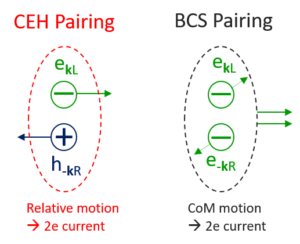
BCS Mechanism:  [ Electron (Left) ]  <=========>  [ Electron (Right) ]  --> Center-of-mass motion
CEH Mechanism:  [ Electron (Left) ]  <=========>  [   Hole (Right)   ]  --> Relative internal motion
A stark contrast immediately emerges: BCS superconductivity conducts electricity through the center-of-mass motion of electron pairs, whereas CEH superconductivity conducts via the relative internal motion of the paired electron and hole (since each individual CEH pair is electrically neutral). Macroscopically, however, both mechanisms manifest as a characteristic $2e$ supercurrent. This relative motion transport mechanism perfectly explains the vital role that flat bands play in non-BCS superconductivity.
The Quantum Mixing of Eigenstates
The Bogoliubov transformation demonstrates that pairing mechanisms originate from a mismatch between distinct eigenstates. The electron-hole (or chiral CEH) interaction eigenstates undergo a unitary rotation (mixing) relative to the energy eigenstates of the Bogoliubov quasiparticles.
Intriguingly, this is mathematically identical to the mechanism driving neutrino oscillations and ordinary-to-mirror neutron oscillations.
-
In particle oscillations, propagation through extended classical spacetime is dictated by the energy eigenstates.
-
In superconductivity, the quantum statistical distributions (e.g., the Fermi-Dirac distribution) represent probability distributions based on these same energy eigenstates.
Consequently, whenever a system possesses two or more close (but not completely degenerate) energy eigenstates, phenomena analogous to quantum oscillations or superconductive pairing condensation will naturally occur.
While traditional Cooper pairing naturally thrives in weakly correlated ($\lambda \ll 1$) electron systems, the CEH pairing mechanism intrinsically demands strong correlation ($\lambda > 1$). This explains why Cooper pairs despise magnetism, whereas CEH pairing actively embraces antiferromagnetism. In antiferromagnetic materials, the electron spins of nearest-neighbor lattice sites are perfectly opposite. Through strong correlation, these two electrons exchange their respective holes and condense with holes of the opposite chirality, triggering robust high-temperature superconductivity.
Validating the CEH Model against Experimental Anomalies
By analyzing pairing symmetries, the CEH mechanism yields two distinct classes of gap equations: s-wave and d-wave superconductivity, which map beautifully onto iron-based and copper-based high-temperature superconductors, respectively.
1. The Energy Gap Ratio ($\Delta_0/T_c$)
For decades, experiments have shown that the ratio of the zero-temperature energy gap to the critical temperature ($\Delta_0/T_c$) in d-wave cuprates is $3$ or higher. Similarly, the newer s-wave iron-based superconductors exhibit measured ratios greater than $2$.
These values flatly contradict BCS predictions but perfectly match the calculations of the CEH model:
| Superconductor Type | BCS Theory Prediction | CEH Model Prediction | Experimental Observation |
| s-wave (Iron-based) | $\Delta_0/T_c = 1.76$ | $\Delta_0/T_c > 2.0$ | Verified ($>2.0$) |
| d-wave (Copper-based) | $\Delta_0/T_c = 2.14$ | $\Delta_0/T_c \geq 3.0$ | Verified ($\geq 3.0$) |
Furthermore, CEH uniquely predicts that weaker strong-correlations or lower doping levels will cause the $\Delta_0/T_c$ ratio to skyrocket, matching experimental data precisely.
2. Energy Gap Survival at $T_c$
Standard BCS theory requires the energy gap to close precisely at the critical temperature ($T_0 = T_c$). Even Eliashberg theory—the standard extension of BCS for strong electron-phonon coupling—adheres to this rule.
However, high-temperature superconductors notoriously display a non-zero energy gap at $T_c$, with the deviation becoming more severe at lower doping levels. Miraculously, CEH calculations mirror this behavior. The CEH mechanism natively defines a separate temperature $T_0 > T_c$ where the gap actually closes, generating a theoretical phase diagram that aligns seamlessly with empirical data for both cuprates and iron-based superconductors.
Energy Gap (Δ)
  ^
  │  \   CEH Model (Gap remains open at Tc, closes at T0)
  │    \_______
  │    \       \
  │     \       \
  │      \ BCS   \
  └───────┴───────┴────────> Temperature (T)
         Tc       T0
3. The Anomalous Specific Heat Linear Term
In the early days of cuprate research, physicists discovered an anomalous linear term in the specific heat capacity—meaning the ratio $C/T$ does not equal zero at absolute zero ($T \rightarrow 0$). This cannot be explained within the BCS framework.
In addition to this non-zero residual value, experiments confirmed that the behavior of $C/T$ near absolute zero scales with the square of the temperature ($T^2$). The CEH model’s d-wave calculations reproduce both of these thermodynamic features natively—a feat no other theoretical model has achieved.
Outlook
The theoretical elegance and flawless experimental consistency of the Chiral Electron-Hole pairing mechanism strongly suggest it is the correct, definitive theory for high-temperature superconductivity.
While experimental research into high-temperature superconductors has slowed down in recent years, targeted verification work—such as precisely mapping the gap-closing temperature $T_0$—could easily spark a new renaissance in condensed matter physics. Ultimately, the CEH mechanism provides the exact predictive framework needed to design and discover superior high-temperature superconducting materials, paving the way for the next technological revolution.
Exploring the Mirror World 17 — Geometric Langlands and Mirror Theory
The Langlands program is a series of far-reaching conjectures in mathematics designed to connect and unify disparate fields—particularly number theory, algebraic geometry, and group representation theory. It is frequently hailed as the “Grand Unified Theory” of mathematics.
This unifying vision—the idea that different mathematical branches are merely describing the same mathematical reality through different abstract languages, acting as a mathematical Rosetta Stone—originated from a profound insight by the great mathematician André Weil in a letter to his philosopher sister. The actual blueprint of the program, however, came from another letter: a 17-page handwritten missive sent by Robert Langlands to André Weil in 1967. This monumental research initiative has guided contemporary mathematics ever since, directly enabling Andrew Wiles’s world-renowned proof of Fermat’s Last Theorem.
The geometric Langlands correspondence can be understood as the geometric translation (applicable to algebraic curves and Riemann surfaces) of the original Langlands program over number fields. In May 2024, a nine-person collaborative team led by Dennis Gaitsgory announced that after decades of grueling effort, they had finally resolved the geometric Langlands conjecture. Their complete proof spans five papers and over a thousand pages of rigorous argumentation. Early indicators and validation from the broader mathematical community strongly suggest their proof is correct.
What, then, is the true physical meaning behind geometric Langlands?
The Crux of Langlands Duality
At its core, the Langlands program is an incredibly deep and abstract extension of Galois group theory and its representation theory used to link diverse mathematical subfields. A particularly magical aspect of this framework is that given a group $G$ (such as a gauge group in physics), one can construct a Langlands dual group $^LG$, whose root datum is precisely the involution (the dual) of the root datum of group $G$.
This Langlands duality is the golden key to unlocking its physical meaning. Its direct connection to mirror symmetry in Mirror Matter Theory is the focal point of this article.
       [ Gauge Group G ]  <─── Root Data Involution ───>  [ Langlands Dual Group ᴸG ]
               │                                                      │
               ▼                                                      ▼
  Ordinary Particle Sector                                  Mirror Particle Sector
(e.g., Left-Handed Weak SU(2))                             (e.g., Right-Handed Weak SU(2)')
In 2007, Anton Kapustin and Edward Witten published a seminal 200-page paper (“Electric-Magnetic Duality And The Geometric Langlands Program” [Comm. Num. Theory & Phys. 1 , 1 (2007), arXiv:hep-th/0604151]) detailing the relationship between geometric Langlands duality on Riemann surfaces and S-duality in quantum field theory. Witten noted that Sir Michael Atiyah was likely the first to glimpse this connection back in 1977, arising from the very first discovered instance of S-duality: Montonen–Olive duality (frequently called electric-magnetic duality) [Phys. Lett. B72, 117 (1977)].
However, interpreting this purely as standard electric-magnetic duality is a profound misunderstanding. Within the framework of supersymmetric mirror field theory, the correct paradigm is as follows:
-
The dual of the ordinary electric field is the mirror magnetic field.
-
Conversely, the dual of the mirror electric field is the ordinary magnetic field.
This electromagnetic swap inverts the orientations of the ordinary and mirror fields, which is precisely the hallmark of mirror symmetry.
The Pragmatic Misconception of Duality
When theoretical physicists discuss these dualities, they routinely fall into a systemic trap: they treat them strictly as dualities between two different theories. This pragmatic perspective allows them to use the mathematical tools of one theory to solve tricky non-perturbative calculations in a dual theory, but it has severely stalled them from using these mathematical breakthroughs to advance actual Mirror Matter Theory. We encountered this exact bottleneck when examining the relationship between mirror theory and superstring theory.
These mathematical relationships are not just formal mappings between abstract models; they explicitly map the duality between the ordinary particle world and the mirror particle world.
Montonen–Olive duality holds strictly under $N=4$ supersymmetric gauge field theory [Phys. Lett. B83, 321 (1979)], serving as a concrete realization of the geometric Langlands correspondence. While string theorists prefer to view the resulting coupling constant symmetry ($g \rightarrow 1/g$) as a tool to bridge strong and weak coupling regimes across separate theories, its true physical essence is an implementation of mirror symmetry.
Because mirror symmetry operates as a local orientation symmetry in quantum field theory (see What Exactly Are Mirror Symmetry and Supersymmetry?), it manifests in 4D spacetime as a duality between the ordinary and mirror particle sectors. Therefore, Montonen–Olive duality maps the gauge interactions of our ordinary particle world (e.g., $U(1)$) to the anti-oriented gauge interactions of the mirror particle world (e.g., $U'(1)$).
Physical Realization: SMM4b and Seiberg Duality
Recent breakthroughs in Mirror Matter Theory have cemented its deep ties to superstring theory (see Superstring Theory and Mirror Theory and Symmetry, 15(7), 1415 (2023)). Specifically, the 4D supersymmetric mirror models yield an $N=1$ supersymmetric ultraviolet field theory (SMM4) and an $N=4$ pseudo-supersymmetric infrared field theory (SMM4b).
The SMM4b model naturally produces the familiar Standard Model gauge interactions of our ordinary particle sector:
Concurrently, the anti-oriented gauge interactions of the mirror particle sector are generated as:
This is the exact physical manifestation of the Langlands dual group:
By compactifying this 4D supersymmetric field theory duality, we naturally transition to 2D T-duality (see [Nucl. Phys. B448, 166 (1995)] and [Phys. Rev. D52, 7161 (1995)]). This represents the unitary evolution of the supersymmetric mirror models between 4D and 2D spacetime—a flawless physical execution of mirror symmetry. The mathematical Langlands dual is, fundamentally, the physical mirror symmetry dual.
Another related framework, Seiberg duality (Nucl. Phys. B. 435, 129, 1995), is a distinct form of S-duality that establishes a mapping between two $N=1$ supersymmetric theories, where a gauge group $SU(N_c)$ maps to a dual group $SU(N_f – N_c)$. This matches the quark sector of the high-energy SMM4 model. With three color charges ($N_c = 3$) and six quark flavors ($N_f = 6$), the Seiberg dual yields:
The latter is precisely the gauge interaction governing mirror quarks.
The Dynamic Evolution of the Universe
The most profound connection to geometric Langlands lies in the dynamic unification of our physical world.
According to the Principle of Spacetime Inflation in Mirror Matter Theory, spacetime inflates sequentially, dimension by dimension, through dimensional phase transitions. Each dimension defines its own emergent matter fields and forces.
The Rosetta Stone methodology of the geometric Langlands program—bridging entirely different branches of mathematics—captures this exact dimensional phase transition of spacetime.
This progression mirrors the evolution of the cosmos from 0-dimensional quantum chaos up to our extended 4D universe, providing a mathematical language for the fractal dimensions of transitional phases while preserving the unitarity and holography of cosmic evolution.
Our universe may well have been born from the properties of prime numbers. Mathematical frameworks of grand unification like geometric Langlands are not mere abstract curiosities—they are a direct reflection of the dynamic, evolving unity of our cosmos.
Exploring the Mirror World 18 — Why Mirror Theory?
Since the modern foundation of fundamental physics was finalized over half a century ago—marked by the establishment of the Standard Model—our understanding of the physical world has achieved astonishing precision. Yet, we know it is certainly not the ultimate theory. The framework is plagued by too many free parameters (19, even excluding those for neutrinos), seemingly arbitrary interactions, an unexplained number of particle generations, and the stubborn non-conformity of gravity. Furthermore, it remains entirely blind to cosmological mysteries like dark energy and dark matter.
Decades of effort have yielded numerous candidates for physics Beyond the Standard Model (BSM). So, why do we confidently assert that the new Mirror Matter Theory is the next theoretical monument we have been dreaming of?
The new Mirror Matter Theory discussed here began in 2019 and was laid out in a series of core peer-reviewed papers: Phys. Lett. B 797, 134921 (2019); Phys. Rev. D 100, 063537 (2019); Int. J. Mod. Phys. D 30, 2142020 (2021); Universe 2023, 9(4), 180; and Symmetry 2023, 15(7), 1415, and other unpublished preprints.
The Current Crisis in Fundamental Physics
The most popular BSM candidates typically center around Quantum Gravity, specifically String Theory and Loop Quantum Gravity. However, these frameworks harbor a fatal flaw: they yield no genuinely verifiable predictions, rendering them experimentally untestable for the foreseeable future. They behave more like mathematical exercises lacking foundational physical principles.
Concurrently, we are inundated with phenomenological BSM models. These are rarely ambitious; most are custom-built toys designed to patch one or two specific data anomalies. Their mechanisms and parameters are notoriously ad hoc, engineered solely to fit highly specific datasets. They possess virtually no predictive power. Deep down, theorists acknowledge their futility, but academia must keep churning. While a few brilliant ideas emerge that might inspire future breakthroughs, the vast majority are destined for the dustbin of history.
On the experimental front, researchers are largely consolidated into massive collaborations—sometimes exceeding thousands of members—pursuing “Big Science” via monolithic, expensive facilities. A few small teams conduct tabletop experiments to hunt for new physics, but the vast majority of these endeavors lack solid theoretical guidance; they are effectively chasing a moving target. In the hunt for dark matter or neutrinoless double beta decay ($0\nu\beta\decay$), giant collaborations continually optimize precision and sensitivity, but they may well be refining their search for signals that simply do not exist.
Three Pillars of a Great Physical Theory
Physicists understand what constitutes a successful theory.
-
Compatibility: It must not contradict established, verified experimental observations. You cannot break a well-understood phenomenon just to explain a new anomaly.
-
Elegance: It must possess simple, beautiful mechanisms and principles. An ugly, convoluted theory is rarely correct.
-
Testability: It must possess concrete predictive power and outline feasible methods for experimental verification.
Historical milestones showcase these exact traits. Special Relativity perfectly reduces to Newtonian mechanics at low velocities; its elegant principle of relativity provides a profound symmetry, and light electrons are easily accelerated to relativistic speeds to test it. Similarly, Lee and Yang’s theory of parity violation in weak interactions explicitly proved that previous experiments had never actually tested parity conservation. The broken symmetry revealed a new form of cosmic beauty, and their proposed $\beta$-decay experiment was swiftly verified by Chien-Shiung Wu.
In contemporary physics, string theory fails the third criterion. Most other phenomenological models fail the first (fixing one problem only to pop up another) or are too heavily patched to be elegant. Many satisfy none.
Let us examine how the new Mirror Matter Theory fulfills all three criteria flawlessly.
Pillar 1: Flawless Compatibility
The new theory dictates that no cross-sector gauge interactions exist between the ordinary and mirror sectors. Because they do not share forces like electromagnetism, the entire corpus of Standard Model physics remains fully intact, preserving its sub-parts-per-trillion experimental precision.
Because dark matter is simply mirror matter, it cannot be directly captured by standard dark matter detectors. Furthermore, because neutrinos are strictly Dirac fermions in this framework, neutrinoless double beta decay is strictly forbidden. This elegantly explains why both massive experimental sectors remain entirely empty-handed despite decades of highly sensitive searches.
The only way the mirror world interfaces with our ordinary sector is through the oscillation or topological transition of neutral hadrons between the two worlds. The most prominent channels are neutron ($n\text{-}n’$) oscillations and neutral kaon ($K^0\text{-}K^{0\prime}$) oscillations.
-
The Neutron Lifetime Anomaly: The long-standing discrepancy in neutron lifetime measurements is naturally resolved by $n\text{-}n’$ oscillations. The resonance condition required by their mass difference is incredibly stringent, meaning it does not disrupt everyday physics on Earth. It requires either matter densities hundreds to thousands of times that of water (which perfectly explains late-stage stellar evolution and nucleosynthesis) or ultra-strong magnetic fields ($50\text{–}200\text{ T}$) that can only be generated as fleeting pulses in a handful of advanced laboratories.
-
Neutral Kaons: The measured mass difference in well-studied ordinary kaon oscillations (which led to the discovery of CP violation) aligns with stunning precision with the predictions of mirror theory. Concurrently, the mirror-linked invisible decay of $K^0$, heavily dictated by $(K^0\text{-}K^{0\prime})$ oscillations, remains untested by current experiments.
All of these factors demonstrate a remarkably high level of compatibility with the Standard Model.
Pillar 2: Architectural Elegance
Mirror symmetry maps directly to a universal geometric property: orientation symmetry. All geometric manifolds naturally possess local orientation symmetry. Consequently, the elementary particles defined by local quantum field theory spaces must inherit this mirror symmetry, manifesting as two distinct particle branches with opposite orientations.
This elegant concept directly unifies string theory’s T-duality and Calabi-Yau mirror symmetry, reinterpreting heterotic strings by injecting tangible physical content into abstract mathematics. It seamlessly links to the grand architecture of the geometric Langlands correspondence.
Furthermore, the framework achieves an extreme economy of design. It introduces no redundant, ad hoc interactions. Every interaction, particle spectrum, and spacetime dimension evolves spontaneously via sequential dimensional phase transitions and spontaneous symmetry breaking.
Astonishingly, this single, self-consistent framework addresses almost every major puzzle in fundamental physics and cosmology:
-
Dark energy and dark matter
-
Baryon asymmetry (matter-antimatter imbalance)
-
Ultra-high-energy cosmic rays
-
The arrow of time
-
The Big Bang and inflation
-
Black hole interiors
-
Stellar evolution and nucleosynthesis
-
Supernova explosion mechanisms
-
The origin of particle generations and interactions
-
Neutrino properties
-
The neutron lifetime anomaly
-
CKM matrix unitarity
It even extends a fresh pairing mechanism to condensed matter physics, providing an exceptional match for unconventional high-temperature superconductivity data.
Pillar 3: Concrete, Feasible Testability
The $n\text{-}n’$ oscillation model in the new theory depends on just two tightly constrained parameters:
-
Mixing Strength: $\sin^2(2\theta) \sim 0.8\text{–}2 \times 10^{-5}$ (half of which represents the probability of an ordinary neutron transforming into a mirror neutron during an incoherent scattering event with ordinary matter).
-
Mass Difference: $\Delta \sim 3\text{–}12\ \mu\text{eV}$.
Measuring one automatically locks in the other. Measuring both provides an immediate opportunity for falsification if they prove incompatible. Notably, detecting any non-zero value for these parameters would constitute definitive proof of new physics.
At least three distinct classes of experiments can immediately subject the unique predictions of Mirror Matter Theory to rigorous laboratory testing using highly feasible, cost-effective technologies:
1. Miniature Magnetic Traps
By reconstructing small-scale magnetic traps to measure the neutron lifetime anomaly, researchers can exploit the fact that narrower traps increase the reflection frequency of neutrons against the magnetic walls, thereby amplifying the anomaly. This setup can precisely isolate the mixing strength $\sin^2(2\theta)$ and rigorously map the predicted relationship between the apparent neutron lifetime and the physical dimensions of the trap.
2. Ultra-High Magnetic Field Resonances
Utilizing pulsed magnetic field facilities capable of reaching $100\text{–}300\text{ T}$ (such as those at Los Alamos National Laboratory), experimentalists can hunt for the resonant $n\text{-}n’$ oscillation signal. The theory predicts the most probable resonance window to lie between $50\text{–}200\text{ T}$. If a massive, abrupt disappearance of neutrons is observed at a specific magnetic threshold, it will serve as a definitive, unassailable confirmation of the theory while simultaneously pinning down the exact mass difference $\Delta$.
3. Neutral Hadron Invisible Decays
The theory predicts testable invisible decay branching ratios for long-lived neutral baryons and mesons driven by universal $h\text{-}h’$ oscillations. These values are fully within the reach of existing accelerator facilities:
Conducting these searches at active accelerator complexes would provide powerful validation for the theory’s scalability.
A Call to Action
No matter how extraordinary a theory is, it cannot mature or find meaningful application if it remains unexamined and untested. We eagerly invite researchers across the globe to engage with this framework, whether independently or through collaborative channels, to collectively test and advance its principles.
We strongly urge funding agencies and private investors to look closely at this new paradigm. Unlike the multi-billion-dollar infrastructure demands of traditional high-energy physics, the experimental validations outlined above are largely tabletop operations, requiring budgets on the scale of a few million dollars or less. Confirming the existence of the mirror universe within our lifetime would be a monumental triumph for science—and a profound privilege to witness.
Resources & Ecosystem
-
Official Website: https://mirroruniverse.org/
-
Reforming Academic Evaluation: Learn more about our vision for a decentralized, community-driven approach to scientific validation via the Community-driven Open Research Ecosystem (CORE).
