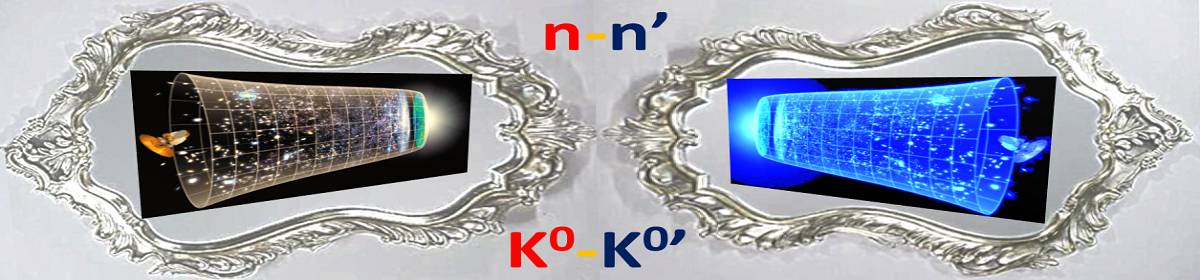
Consistent origin of matter-antimatter imbalance and dark matter in the early universe

This is an excerpt for media people or science journalists. A good story could be written from my two newly published papers (out of six). My personal goal would be to wake up some of the most relevant experimentalists. This should be a win-win situation and I hope it won’t fall on deaf ears. Here is the plain-English summary of the two published works (arXiv:1902.01837 & arXiv:1904.03835):

Matter-antimatter asymmetry and dark matter as two of the biggest puzzles in the Universe can be consistently and quantitatively understood under a new mirror-matter theory. The new theory assumes that there exist two parallel sectors of particles that share nothing but gravity and it leads to neutral particle oscillations because of slightly broken mirror symmetry. Specifically, neutron and kaon oscillations with new understanding of quark condensation and phase transition processes in the early Universe provide the necessary mechanism. The idea is that kaon oscillations first create a potential amount of matter-antimatter asymmetry at the stage of strange quark condensation. A new topological transition process (coined “quarkiton”) can then preserve the generated matter-antimatter asymmetry. Without such an asymmetry, we would not have lived in a universe of galaxies and stars. In the end, neutron oscillations convert most of the matter to mirror matter which corresponds to the dark matter we have observed today. Under the same framework, another so-called U(1) or strong CP problem that has baffled particle physicists for almost half a century is understood as well.

Continue reading “Consistent origin of matter-antimatter imbalance and dark matter in the early universe”

Paper on matter-antimatter imbalance (another M\(^3\) work) accepted for publication

Another paper for the study of baryon asymmetry of the universe based on the mirror-matter model (M3) has just been accepted for publication in Phys. Rev. D.

This is another piece of work that firmly establishes the connections between the new mirror-matter model and cosmology. It is also the bridge leading to the full-fledged extended Standard Model with Mirror Matter (SM3).

Continue reading “Paper on matter-antimatter imbalance (another M\(^3\) work) accepted for publication”

30th anniversary get-together party for class of 1989 of Peking University

Today the get-together party is held in Beijing for the undergraduates of Peking University who got admitted 30 years ago. Class of 1989 in China means the students entering college in 1989 while the year is referred to the graduation year in US. I guess the reason is that it is much more difficult to get admitted to than to graduate from college in China, especially a good one and in the old days. So it is quite an achievement and warrants the use of the entering year for the class. It is the opposite in US.

I am in the same class although not celebrating together with them today. My best wishes to the whole class from overseas. I spent five years, part of the best years of my life, with these brilliant young people. I cherish every moment of those years. I can not help reminiscing about old times while watching the photos and videos my classmates have shared.

Here is the link of the song for the 30th anniversary “Hu Bu Gui” made and sung by two of our classmates:

[胡不归]  北大89级同学30年聚会   作词:王芳    作曲:刘森、袁剑松   演唱:袁剑松

The lyrics: Continue reading “30th anniversary get-together party for class of 1989 of Peking University”

A battle to publish my mirror-matter papers

Over the course of half a year since the birth of my mirror-matter model (MMM or M3), it’s been quite a battle to get any of my M3 related papers to be published on major journals. Here I put together some of the comments from the editors and reviewers to get a glimpse of how “friendly” esteemed scientists are when facing new ideas proposed under a relatively unknown name.

Continue reading “A battle to publish my mirror-matter papers”